Meet “Salt”
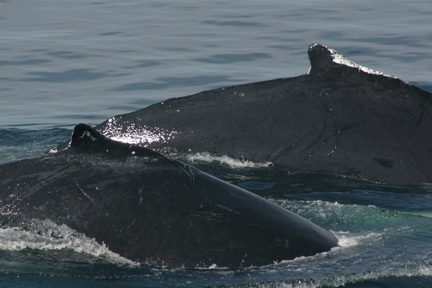
Dorsal fin of Salt (right) and her calf, Soya (left). Note the white scarring on Salt’s dorsal fin that seems like a coating of salt.
A humpback whale named Salt has played an important role in our research. One of our staff and founders, Dr. Charles “Stormy” Mayo, was the first scientist to observe her in the mid-1970s. The sighting occurred when Stormy joined Aaron Avellar and the rest of the Dolphin Fleet crew in their first trips of commercial whale watching. We have since resighted and studied Salt more than any other individual whale, documenting her in every year since her first sighting. Many consider her the ‘Grande Dame’ of Stellwagen Bank because of the frequency with which she is seen here. Our studies of Salt and other humpback whales in this region have formed the basis of our Gulf of Maine humpback whale catalog and database. In addition to her extensive sighting history in the Gulf of Maine, we have also observed Salt on her breeding ground during our own research in the West Indies.
In that first year, Aaron Avellar bestowed names on “Salt” and her companion “Pepper” based on the differences that they observed in their dorsal fins. Salt was named for white scarring on her dorsal fin that looks like a layer of salt, while “Pepper” had a black dorsal fin without scarring. What began on a whale watch boat (and later a small group in Stormy’s living room in Provincetown) is now a long-standing community tradition in this region. The Gulf of Maine humpback whale naming is organized and moderated by CCS (previously along with our colleagues at the former Whale Center of New England). However, Aaron’s family still has the unique honor of naming all of Salt’s calves.
Long-term studies provide critical information for humpback whale science and conservation. Our scientists have not only carefully documented Salt, but also every calf that she brought to the Gulf of Maine, every grand-calf and every great grand-calf. Such detailed studies of individuals help us to understand them as well as humpback whale biology, population status and threats more generally. As just one example, genetic samples that we collected from Salt and her calves in the early 1990s allowed CCS scientists to prove that female humpbacks are promiscuous (their calves do not have the same fathers). We specifically chose our genetic sample from Salt to be the basis of research that led to the first sequenced humpback whale genome, a study that allowed us to uncover new information about cancer prevention mechanisms. Decades after our first sighting, Salt continues to teach us about the inner world of the humpback whale and beyond. For more details about our research, see our scientific publications.