Agnes Mittermayr, a marine ecologist at the Center for Coastal Studies, has been tapped to join a team of about three dozen global experts in the 2030 Seagrass Breakthrough, a UN effort to conserve critical seagrass ecosystems.
In December, 2023, at COP28 (United Nations Framework Convention on Climate Change, Conference of Parties 28) in Dubai, the Convention of Migratory Species Office announced the 2030 Seagrass Breakthrough to establish a collective framework of action for global seagrass conservation.
Mittermayr is a leading expert on seagrass, and was named last year as director of SeagrassNet, an international seagrass database.
2030 Seagrass Breakthrough’s Goal
A Breakthrough is a compass, or roadmap, with which stakeholders work together to set goals and chart a course toward achieving those goals.
The 2030 Seagrass Breakthrough’s goal is to conserve 150,000 square kilometers of seagrass by 2030, and mobilize $1.2 billion in funding. To accomplish this, it aims to:
- Halt seagrass loss globally
- Facilitate recovery of degraded seagrass
- Double protection of seagrass
- Ensure sustainable long-term financing.
It’s part of a broader Ocean Breakthroughs initiative, which has four breakthroughs: corals, mangroves, kelp, and seagrass.
Following the announcement last December, and the drafting of general goals and guiding principles, the assembled seagrass experts will now meet to begin to develop detailed strategies that will be discussed at this year’s COP29. Their first meeting will be virtual and is scheduled for Sept. 2.
Why Is Seagrass Important to the Ecosystem?
Seagrass is a vitally important ecosystem that supports;
- Biodiversity
- Cycles and stores nutrients and pollution
- Protects coastal areas
- Provides nurseries for larger fisheries
- Mitigates climate change through highly effective carbon sequestration.
Read more about Mittermayr’s seagrass research.
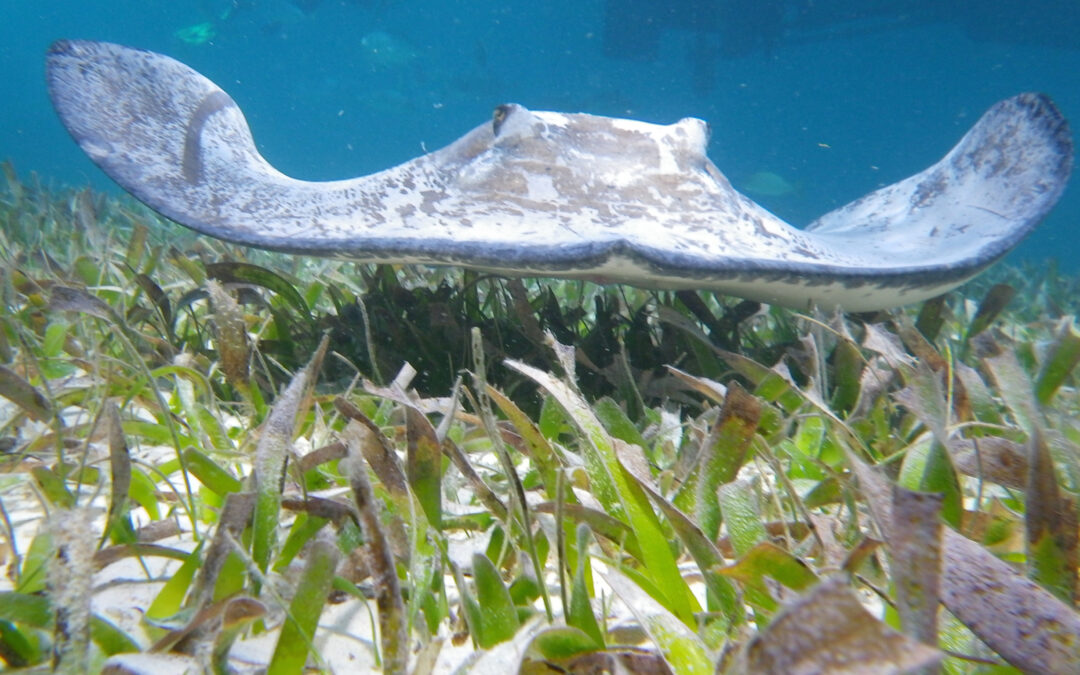
Photo: Stingray swims above seagrass, by Fred Short.
Related Topics
CCS Department of Marine Geology