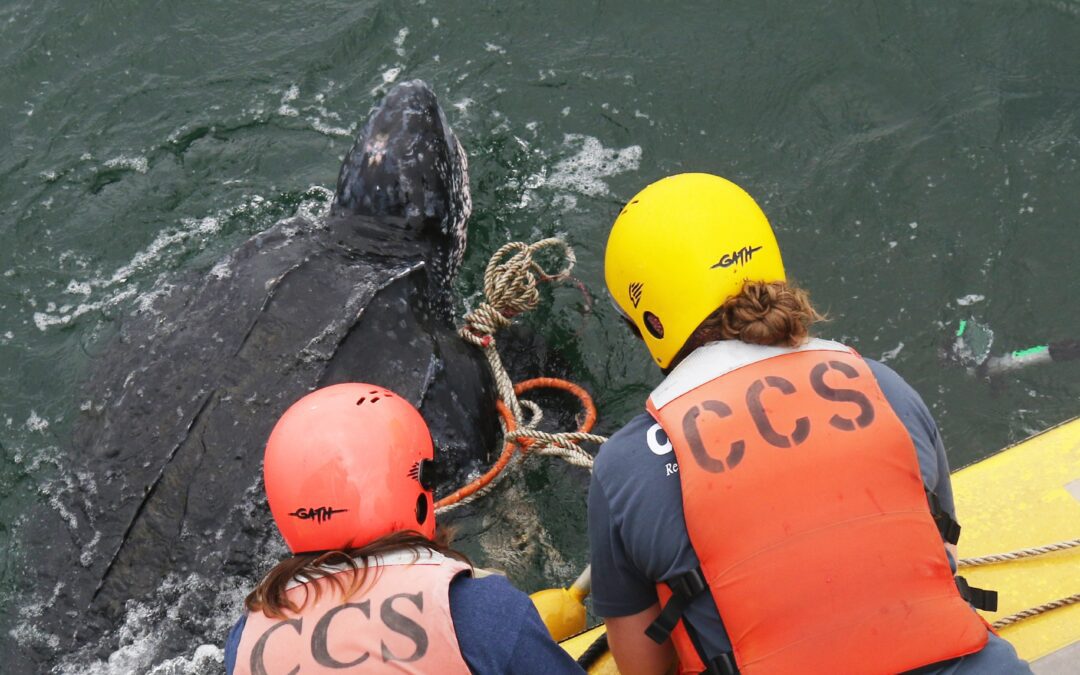
A leatherback sea turtle, the largest sea turtle species in the world, was disentangled last week and is swimming freely in Cape Cod Bay thanks to a joint effort by the Center for Coastal Studies, the New England Aquarium, and the Barnstable Harbormaster.
Disentanglement Effort
On Thursday, July 18, members of the Center for Coastal Studies Marine Animal Entanglement Response (MAER) team were notified of a leatherback turtle entangled in fishing gear in Barnstable Harbor, and came to its aid.
The turtle, which measured about 6 feet long and was estimated to weigh 400 pounds, was disentangled by the MAER team and handed off the responders from New England Aquarium Anderson Cabot Center for Ocean Life for a health assessment including bloodwork, and to be tagged with satellite and acoustic tags for post-release monitoring. The tags applied include an acoustic transmitter, which operates like an EZ Pass transponder, allowing the turtle to be detected for up to ten years by a vast array of underwater receivers that stretch from Canada to Florida.
Scott Landry, director of the MAER team, noted that this was the first leatherback entanglement of the year. Since then, the Center has disentangled two additional leatherback turtles, one in Cape Cod Bay, and the other east of Nauset Beach.
Landry expressed appreciation for the Good Samaritan who immediately called the MAER hotline. Mariners are reminded to stay with the entangled turtles, at a safe distance, until help arrives.
“At the moment we are receiving a rush of entangled whale and sea turtle reports, so any help from the mariner community is much appreciated” said Landry.
Tracking the Rescued Leatherback Turtle
The turtle also received a “survivorship” tag to determine the short-term (30-day) outcome, and a traditional satellite tag that will monitor the turtle’s movements and dive behavior in near real-time for up to a year. The turtle, nicknamed ‘Phinney’ by Barnstable Harbormaster responders, can be followed on the New England Aquarium’s Sea Turtle Tracker.
“It’s critical that we understand the outcomes of leatherback sea turtles after they’re disentangled from fishing gear,” said Kara Dodge, an Anderson Cabot Research Scientist. “We’re using satellite and acoustic tags to monitor their post-release survival and behavior over time. One tag will give us real-time information so that we can keep a watchful eye on this turtle while it’s inhabiting our busy coastal waters this summer and fall.”
Declining Leatherback Turtle Population
Over the last three generations, the global population of leatherbacks has declined 40 percent, and their greatest threat is accidental capture (bycatch) in fishing gear, according to estimates by the National Oceanic and Atmospheric Administration (NOAA). Since 2007, Dodge and her colleagues have conducted various studies about leatherback movements, behavior, and health, with their most recent project focusing on fishing gear entanglements in collaboration with the Center for Coastal Studies and local fishermen.
Reporting Marine Animal Entanglements
Boaters are urged to report any entanglement sightings of whales, sea turtles, or other marine animals to the MAER team (1-800-900-3622) or the US Coast Guard on VHF 16, and to stand by the animal at a safe distance until trained responders arrive.
Health assessment and tagging was conducted under NMFS permit # 21301-01 and funded by the NOAA Bycatch Reduction Engineering Program. CCS disentanglement work is supported in part by grants from the National Marine Fisheries Service (NMFS), the Massachusetts Division of Marine Fisheries (MA-DMF), the Massachusetts Environmental Trust, and private foundations and donors.
Related Topics
CCS’ Marine Animal Entanglement Response