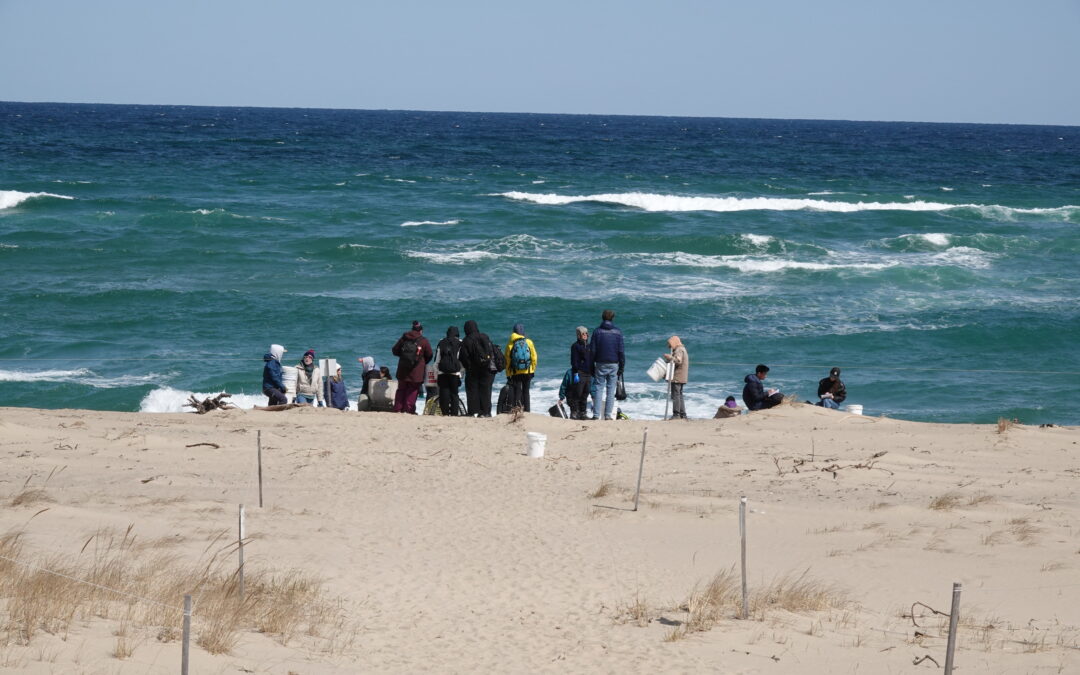
For the fourth consecutive year, the Center for Coastal Studies’ Marine Debris and Plastics Program (CCS MDPP) will host students and their professor from Cornell University for a week-long residency March 29th through April 4th, during which they will learn the ropes of sorting, processing, and documenting fishing gear debris retrieved by vessels or gathered on shoreline cleanups. They will then work with Cape Cod artists on a public installation or presentation.
The CCS-Cornell collaboration formally began in 2023 with their participation in CCS’ first “adventure cleanup” on Cuttyhunk Island, an endeavor funded by the EPA’s SNEP Watershed Implementation Grant (SWIG), which yielded 16,000 lbs. of ghost gear and marine debris during that one week alone. It has continued annually in Provincetown to take advantage of the creative confluence of marine debris science and art.
Professor Annie Lewandowski was first introduced to the CCS MDPP when searching for recovered ghost gear for her multi-media installation about humpback whale songs, Siren. What began as a way for Lewandowski to source materials for Siren has evolved into MUSIC 1213 – Spring Break: Marine Stewardship and Creative Collaboration, a one-credit field study class that leverages the collaboration with CCS to cover a diverse array of music and art-related topics from acoustic communication in marine mammals to using art to provoke thought and foster community engagement.
The 2026 residency will focus on the CCS MDPP’s ongoing ghost gear removal project, providing an opportunity for students to learn about commercial fisheries issues and solutions. Shoreline cleanups, trash tallies, public presentations, and marine debris art open houses will round out the week.
The residency is supported again this year by Courtney Paulsen and the Somerset Inn, the Provincetown Commons, Cornell University and Center for Coastal Studies.