Blog post by Adrianne Lovuolo, Research Assistant
For those who care about the health of our natural world, 2025 was a rough one. When we face existential threats, we often find ourselves asking big questions. Honest answers require us to dig deep. What do we value? Why do we do what we do?
 Hi. I’m Adrianne Lovuolo, the newest addition to the Marine Debris and Plastics Program at CCS, acting as a temporary research assistant. My abbreviated answers to questions I posed above are: a coastal zone free of human refuse, connection to our community, and the feeling of doing SOMETHING. I forcefully reject the nihilism of “why bother?” That line of thinking creates a self-fulfilling prophecy. Why bother documenting the end-of-life fishing gear we receive from fishermen? Why bother raking up microplastics and contaminated soil? Why bother making art with the marine debris removed from the shore, or grappled up from the seafloor?
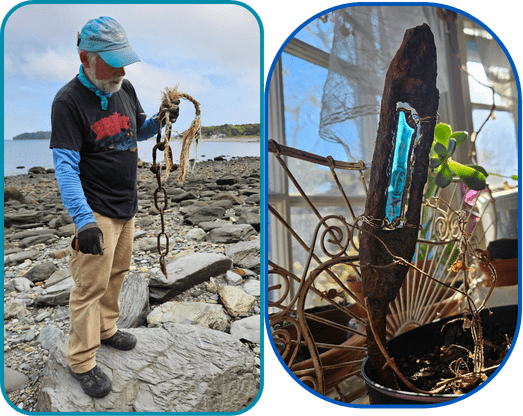
Above Left: Beach Brigadier, Mugg, on Peddocks Island contemplating voids for use in his marine debris artwork. Right: A piece made by Mugg for the author.
Because, to quote science communicator Hank Green, “believing in a hopeful world view actually makes it more likely that the hopeful stuff will come to pass.” Seeing the potential, the beauty, the joy, is what makes life worth living.
That thought is represented by a phrase that I’ve begun to use to explain myself when I’m met with bewildered expressions as I fervently sort out the “Gatorade-” from the “water-” from the “other beverage-” bottles at a cleanup sorting depot. “This is how I scream into the void.”
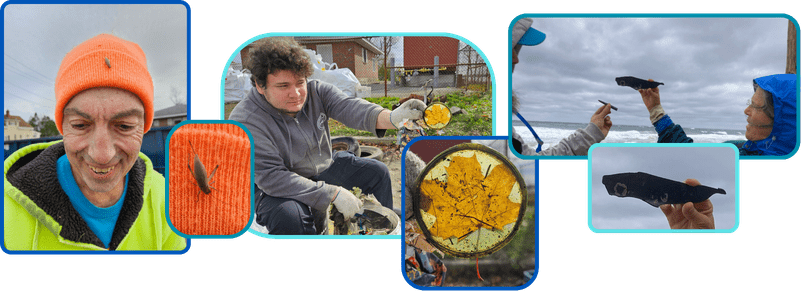
Left: Mark at Marsh Island and his insect friend. Center: Kenny also at Marsh Island seeing the beauty. Right: Anthony and Laurisa during Great Beach Cleanup comparing found objects: a bullet, and a piece of nondescript rigid plastic in which she spotted a whale.
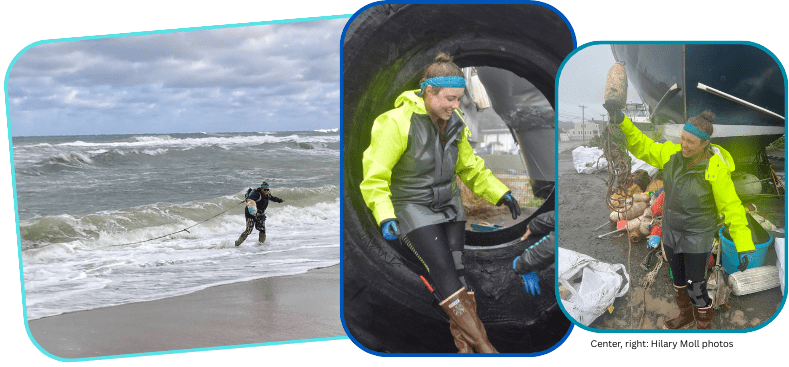 The author hauling fishing gear debris from the surf during Great Beach Cleanup; sitting in an 1800-lb tire removed from Lovells Island; adding a buoy to the pile.
Catharsis is crucial. Every properly accounted for piece of trash contributes, either by count or by weight, to our data sets. Every balloon (2392 in 2025) or tampon applicator (204 in 2025) gathered is one that won’t end up in a sea creature’s gullet. Every plastic object we can collect, to properly dispose of or even just temporarily sequester, has a far lower chance of poisoning our plate, our air, and our bodies. We have plastic on the brain, both metaphorically and literally (Nihart et. al, 2025). Does all this effort matter, if fossil fuel/petrochemical giants and their vast resources are unchecked in their extraction, and their lobbying ensures production remains profitable? I return to the aforementioned quote about believing in a hopeful world. Without hope, we have nothing. Hearts, minds, and investment portfolios won’t all change overnight. Solidarity in hope is what has enamored me of the Beach Brigade. In this circle, I’ve never felt the need to go to lengths to explain myself or justify my passion. The energetic community stitched together by the Marine Debris and Plastics Program and its inceptor Laura Ludwig orchestrate nothing short of magic.
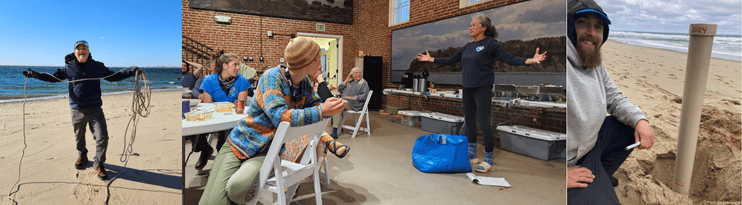 Left: Jack after successfully extricating rope without cutting it. Center: Laura describing something big. Right: Anthony marking time on an embedded pipe.
I have personally witnessed the phenomenon on Adventure cleanups; the force of gravity seems to change, and mountains of rusty lobster traps and treacherous metal-encased foam dock pilings disappear thanks to the lift of a couple hundred hands, local knowledge, and occasionally, heavy machinery.
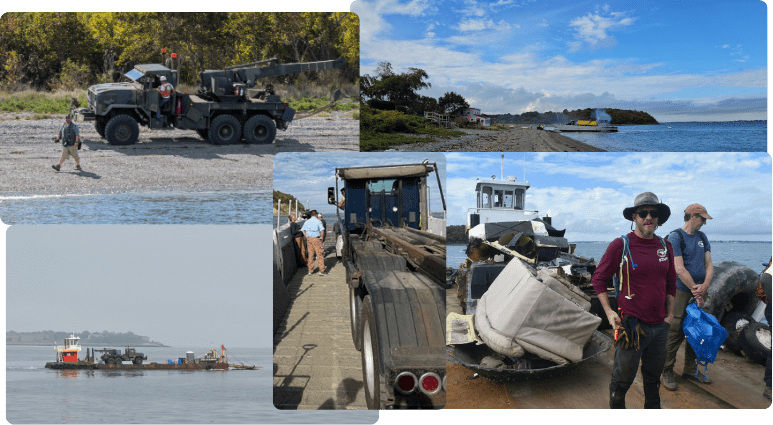
Photos from the Boston Harbor Island Adventure Cleanup 2025.
However, it doesn’t have to be the grand scale of an Adventure Clean to stir something within you. No less impressive is the tally of tens of thousands of pieces of debris, from entire docks to single pearls of styrofoam the size of pin heads.
To participate in a trash tally is to become intimately aware of the breadth, but also the heterogeneity of the problem we face. Currently, we sort and catalog debris into about 270 categories, and that number will continue to grow as we encounter the consequences of our synthetic world. What are we to do with it all? Physically, it presents a conundrum. Much of what we collect at this point can’t be practically recycled, either due to technological or financial (i.e. market) limitations. Exciting advancements have been made in the testing of marine debris as second-life feed stock and other recycling technologies for otherwise “trash” plastics. While we wait for the tide of plastic to change, we may find ourselves doing what humans have been known to do since before we were Homo sapiens: Make art. Whether it’s an enormous public installation, a formal gallery darling, or a petite pendant, art made with marine debris is eye-catching and thought-provoking. It’s a practice that diverts debris from the landfill or the incinerator, for at least a while.
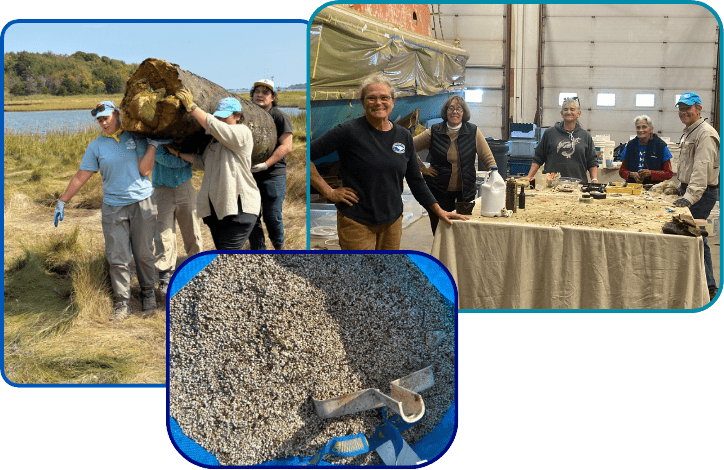 Left: Beach Brigade removes a piling from Peddocks Island. Center: 17.75 lbs of polystyrene foam. Right: Trash Tally from Great Beach cleanup.
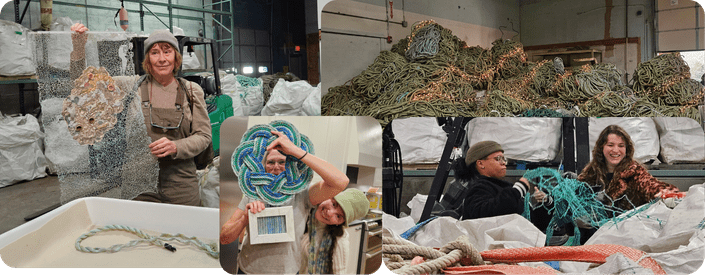
Left: Michelle with fiber art made from old fishing line. Center: Goofing around with a wreath from Wharf Warp. Right: Artists gathering end-of-life net from our storage warehouse.
What do we do with all of this, data-wise? Intellectually? Emotional impacts on an individual, personal-use level are far from the only potent results of our program. Recent legislative changes in Massachusetts regarding the handling of inactive fishing gear are a big win; these changes distinguish between personal property and debris, removing significant hurdles in the way of disposing of derelict gear. This critical regulatory advancement was only possible with the heft of all those data, enabled by this essential industry partnership.

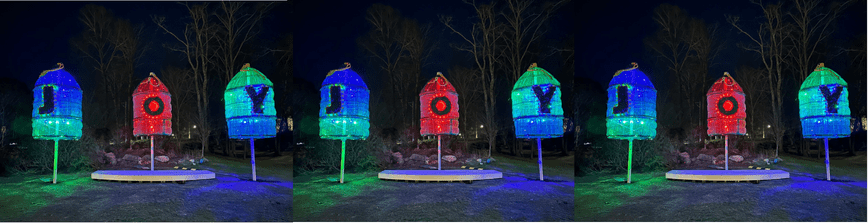
JOY buoys by Scott, Elaine & Beatrice, made from reclaimed metal and fishing gear.
Communication changes minds. Art changes minds. Reporting and data change minds. There they are. Reasons to hope. If nothing else, because it brings us JOY. If that doesn’t matter, why even bother? Thanks for reading.
AL
Nihart, A.J., Garcia, M.A., El Hayek, E. et al. Bioaccumulation of microplastics in decedent human brains. Nat Med 31, 1114–1119 (2025). https://doi.org/10.1038/s41591-024-03453-1
Photos by CCS Staff/the author unless otherwise noted.