CCS Founder Profiles
As we celebrate 50 years of Science That Matters, we honor those individuals whose curiosity, grit, and leadership brought us to where we are today. Their contributions laid the foundation for 50 more years of coastal research, rescue, and education.
Charles “Stormy” Mayo
Charles “Stormy” Mayo III very nearly came into this world on a boat, when a coastal storm drove his parents’ schooner into port. The next day he was born in a Washington, D.C. hospital, as the wind blew hard, and his father gave him the nickname he has carried ever since.
Stormy is (at least) a 9th-generation Provincetown native. His grandfather, Charles, owned and operated a mackerel schooner and employed gill nets out of a dory, and his father, Charles Jr., was a charter boat captain, specializing in tuna fishing. He often brought his young son out on the water and the family cruised the coastline in schooners every year. Stormy’s first memory is crashing through a hatchway as a toddler.
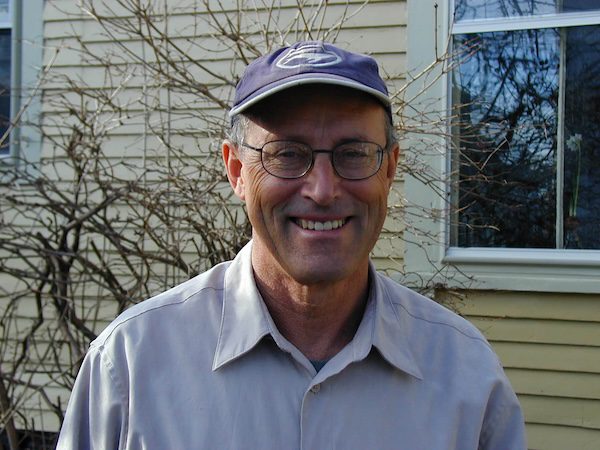
On April 15, 1975, Stormy became the first naturalist on the very first whale watch of the Dolphin Fleet. He quickly brought a scientific approach to the whales he was encountering, developing a data collection system still used to this day, acquiring cameras for photo-identification, and recruiting over the years a talented group of researchers to continue this important work.
Stormy established the fact that Humpback and Fin Whales frequented the Gulf of Maine seasonally and that many individuals displayed site fidelity to the area. His work contributed to the Gulf of Maine Humpback Whale catalogue and later to the first ocean-wide survey of that species, the Year of the North Atlantic Humpback Whale.
Beginning in 1985, Stormy began to focus primarily on the North Atlantic Right Whale, a zooplankton feeder. He established that this species, too, frequented the area seasonally, and in fact Cape Cod Bay was an important feeding and nursing area for these whales. He has authored and co-authored more than 30 scientific papers on right whales, and to this day is working on plankton samples that date back to the 1980s. And, with the Center’s first entangled humpback, Ibis, in 1984, he has been instrumental in the continuing development of disentanglement techniques that are now used around the world.
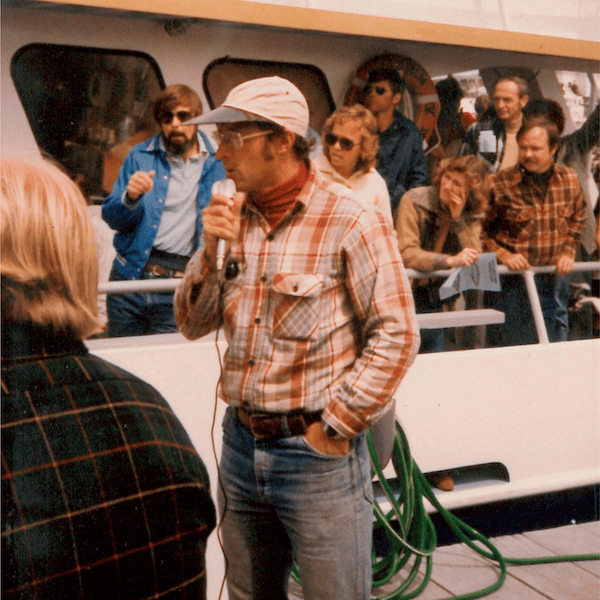
All the while, over the years, Stormy has been for many, the face and the voice of the Center. His charisma, eloquence, and obvious commitment, have enabled him to be a bridge to the media whenever there is a need for public understanding of marine issues.
While officially retired, he is still involved in many ways at the Center, but has more time to devote to the long-neglected Istar, which he and his family and friends now sail along the coast.
The Center has been his life and his life has been essential to the Center. There was a time, in the late 80s, when the future of the Center hung in the balance, after his wife Barbara had passed away and Graham Giese had moved on to Woods Hole, and Stormy thought he, with two small children, could not carry on alone; this little-known juncture of the Center’s existence came down to a private decision that he made in the dunes.He made that fateful decision based on the community of “remarkable” staff and volunteers who were flocking to the Center. Recalled Mayo, these people “bailed me out,” and perhaps they never realized how much they contributed to the very existence of the Center.
“There is a bit of pride in the fact that I made that decision.”
Barbara Shuler Mayo
Driven by her enthusiasm and excitement for the natural world, Barbara Shuler Mayo offered an early vision for what would eventually become the Center for Coastal Studies. Her drive, energy, and generosity were indispensable in its creation.
Dedicated to expanding our understanding of benthic ecosystems, Barbara’s early interest was crustacean systematics – the taxonomy, diversity, and evolutionary relationships of crabs and lobsters. As a Master’s student, she identified new species of hermit crabs, as a PhD candidate, her interest turned to deep ocean lobsters (genus Galacantha).
It was at the University of Miami’s School of Marine and Atmospheric Science that Barbara took the first steps that would eventually lead to the Outer Cape. She met and later married fellow PhD student Charles “Stormy” Mayo. Later, as an established and respected crustacean specialist, Barbara was offered a job at the Smithsonian National Museum in Washington, but instead she chose Provincetown.

In the early 1970s, Barbara and Stormy met geologist Graham Giese when they became involved in studying the environmental impact of a controversial pier proposed for Provincetown Harbor (the project was eventually abandoned). From that relationship the embryo of what would become the Center for Coastal Studies slowly developed.
In its infancy, the Center for Coastal Studies was an educational program, and Barbara, who was devoted to teaching, together with Stormy and Graham, began offering courses on the geology, biology, and natural history of the Outer Cape. Barbara delivered most of the lectures, which were held with a folding blackboard on the beach, in Graham’s office, and at the Cape Codder Guest House owned by the Mayo family. In the early days Barbara also hosted the Center’s Earthwatch program, where citizen scientists helped with benthic research projects in Provincetown Harbor.
In addition to her work at CCS, Barbara served as the Governor’s appointee to the Cape Cod National Seashore Advisory Committee where she was a powerful voice in the move to regulate off-road vehicles in the Seashore’s dunes and wetlands. She was also a principal founder of the Peaked Hill Trust, which protects and preserves the Outer Cape’s historic dune shacks.

Barbara died in 1988 and was survived by Stormy and her two sons, Josiah and Nathaniel, who continue to live in Provincetown and remain dedicated to marine conservation.
Although Barbara did not live to see what eventually emerged from her early vision, her precise approach to research, enthusiasm for the natural world, and love of working in the field are enduring legacies.
Graham Giese
“Right people, right place, right time.” That’s how Dr. Graham Giese explained the creation of the Center for Coastal Studies. He, the Mayos, Provincetown, and the Environmental Decade. A perfect combination.
Giese arrived on Cape in 1956, later settling in Truro with his wife, Rachel, and five children. Prior to that, Graham had studied sediment transport in the Army Corps of Engineers, surveyed shorelines, and conducted research at sea for Woods Hole Oceanographic Institution (WHOI). He received an M.S. at University of Rhode Island and a PhD. at University of Chicago, and joined the faculty at the University of Puerto Rico as Assistant, then Associate, Professor.
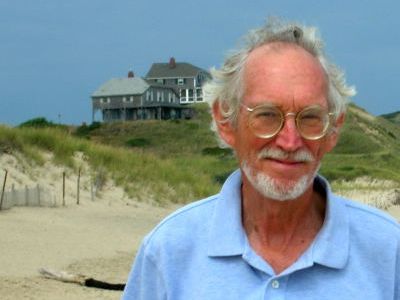
In the early 1970s, Graham was introduced to Barbara and Stormy Mayo when the three conducted environmental research concerning the proposed construction of a controversial pier in Provincetown Harbor. When the Center for Coastal Studies was founded, Graham served as the Executive Director.
Graham’s experience at the Center paved the way for a career of research and public education. A peninsula of sand provided a lot of research opportunities.
In 1974, he highlighted a Cape fact of life with The Eroding Shores of Outer Cape Cod, co-authored by his wife, Rachel Brown, for the Association for the Preservation of Cape Cod.
Following that, Alice Hiscock, Chair of the Chatham Conservation Commission and one of the Center’s first students, asked him to conduct a study of Chatham Harbor. He determined that the barrier beach protecting the harbor was part of a roughly 150-year cycle. Comparing shoreline maps of 1975-1985, 1985-1995 and 1995-2005 with historical data, he predicted that a new inlet would form at approximately the same location as the breach in 1846, and it would probably happen between 1985 and 1995.
His report was widely circulated. Two years later, in January 1987, a breach did occur about a mile south of the historic one. Within two weeks, the trickle had widened to about 500 feet and was deep enough for a commercial fishing boat to go through at half-tide, according to Tim Wood of the Cape Cod Chronicle. Graham’s prediction of both time and location of the new breach was remarkably precise.
Graham takes a long view of coastal changes. He sees the Cape as one large system and the forces shaping all of it as geology in action. In that view, the entire shoreline from Provincetown to Stage Harbor in Chatham is a subsystem, and Chatham Harbor is a smaller subsystem. He knows that’s a difficult concept to grasp when one is more focused on the immediate erosion of one’s own personal property. But Graham became “go to” person to explain anything to do with beaches and banks, currents and waves, and all the coastal processes involved.
While continuing his presence at CCS, Graham maintained his close connection with WHOI. After an appointment as Associate Director of SUNY Marine Sciences Research Center on Long Island, he completed landmark research at CCS and WHOI, begun in Puerto Rico, on a particular type of wave called seiche. He and his CCS assistant Ruth Hollander were funded by the National Science Foundation (NSF), a first for the Center, and published their results in 1982.
While in Woods Hole, Graham worked with WHOI Sea Grant. The Sea Grant had by then merged with Barnstable County Extension Marine Program, bringing him even more public engagement, respect and a reputation as the Cape’s leading coastal geologist. Despite his achievements, he’s quick to credit others.

Graham retired from WHOI in 1996 as “Oceanographer Emeritus.” He continued to publish widely and present his work at professional meetings. He often collaborated with town, county and National Seashore personnel to research Cape environments and has chronicled changes in Chatham Harbor since the initial breach.
He lives in Cambridge with his wife, Barbara and is involved in Center activities when he can.
“We’re scientists and we’re serious people,” he said. “We were just trying to understand the sand.” He’s done that and much more.