50 Years of Science That Matters
CCS right whale research aboard R/V Halos.
The only reason that it became what it became is that people cared about it.
— Graham Giese
Fifty years ago, three scientists from different disciplines came together in Provincetown with a shared belief: that understanding the marine and coastal environment requires long-term, field-based research grounded in real-world questions and direct observation.
Returning to the same waters, shorelines, and habitats over time, they sought to understand how interconnected coastal systems function and how they change in response to both natural processes and human activity.
The Center for Coastal Studies emerged at a pivotal moment. The environmental movement was gaining momentum, marked by landmark legislation including the Endangered Species Act (1973), the formation of the Environmental Protection Agency (1970), and the Marine Mammal Protection Act (1972). At the same time, development on Cape Cod was accelerating alongside growing awareness of human impacts on the natural world.
In this moment, founders Dr. Charles “Stormy” Mayo, Dr. Barbara Mayo, and Dr. Graham Giese created something new: an organization rooted in field-based research, community participation, and the belief that science can connect people to the natural world.
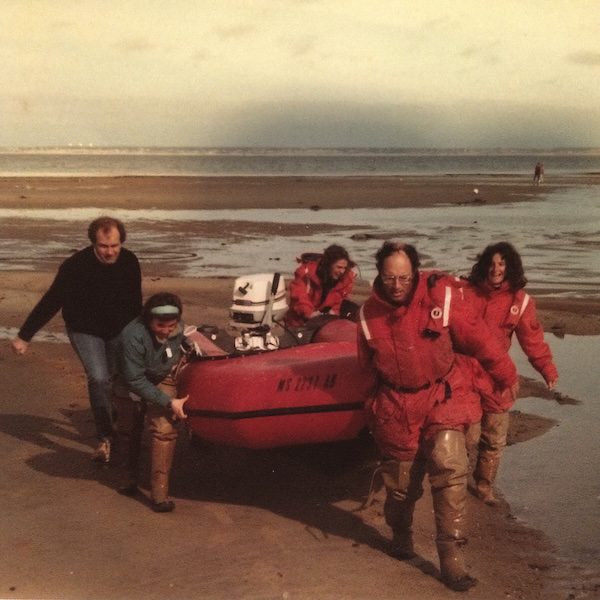
CCS researchers haul a Zodiac ashore during field operations in Provincetown.
The Early Years
The Center for Coastal Studies was officially established in 1976, but its origins began earlier when Dr. Graham Giese, Dr. Barbara Mayo, and Dr. Charles “Stormy” Mayo connected over concerns about the ecosystem effects of a proposed solid-fill pier in Provincetown Harbor. Their response was grounded in science: understanding how coastal systems function, how they change over time, and how human activity shapes the marine environment.
Field ecology classes and collaborative research projects soon followed, bringing students and volunteers directly into this work. One of the first students to participate in those programs was a young Rich Delaney, who would later return to lead the organization as Executive Director.
Provincetown, with its maritime heritage and proximity to the productive waters of Cape Cod Bay and the Gulf of Maine, provided an ideal setting for this work. CCS researchers, staff, and volunteers conducted shoreline surveys, studied harbor ecology and sediment transport, advised management agencies and property owners on coastal change, organized community birdwatching expeditions, and carried out one of the first ecosystem assessments of Provincetown Harbor.
Community support and volunteer participation have shaped CCS throughout its history. Members, donors, students, and local residents contributed to every aspect of the work, from fundraising and administrative support to darkroom work and field research aboard boats and along the shore.
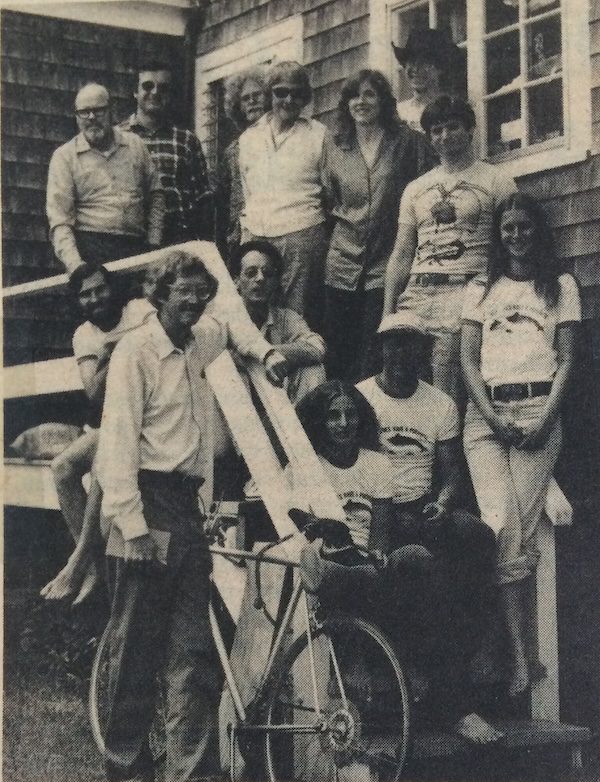
CCS Staff in 1980
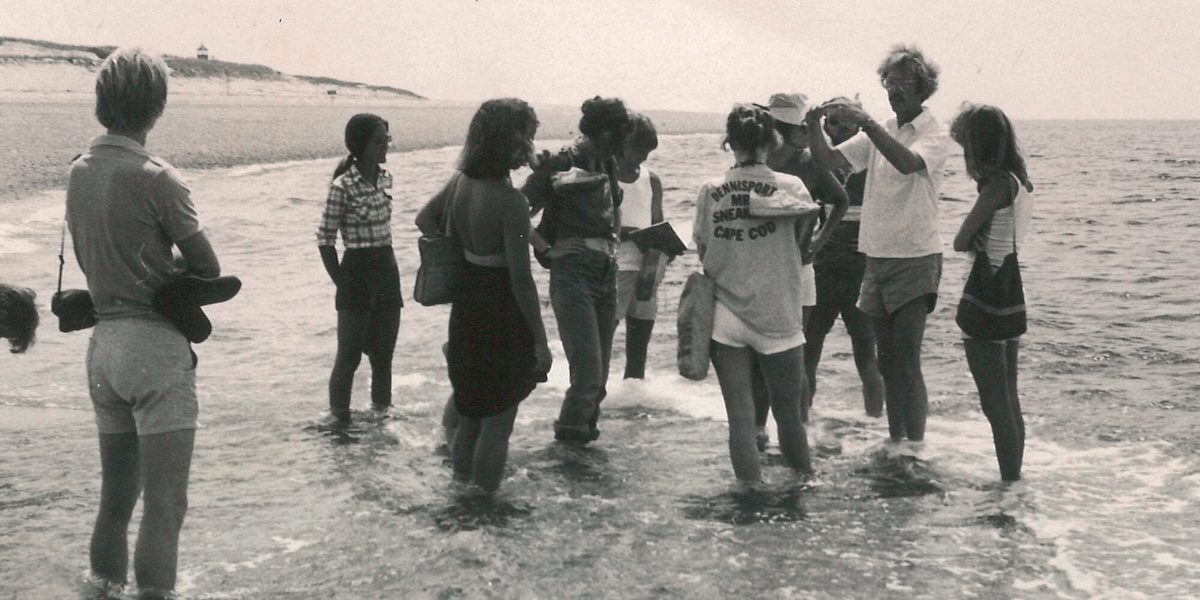
Students participate in an early CCS field ecology program with Graham Giese.
Science With People In It
From the beginning, CCS has been shaped by the people connected to it: scientists, volunteers, educators, artists, fishermen, and others drawn to understanding and protecting the marine environment. This model of community-based science continues today.
Education has always been central to this work. Field programs and public engagement have connected thousands of people to whales and the broader marine environment, providing firsthand experience with marine science and the systems it seeks to understand. For many, these early experiences have led to careers in conservation, education, and environmental science.
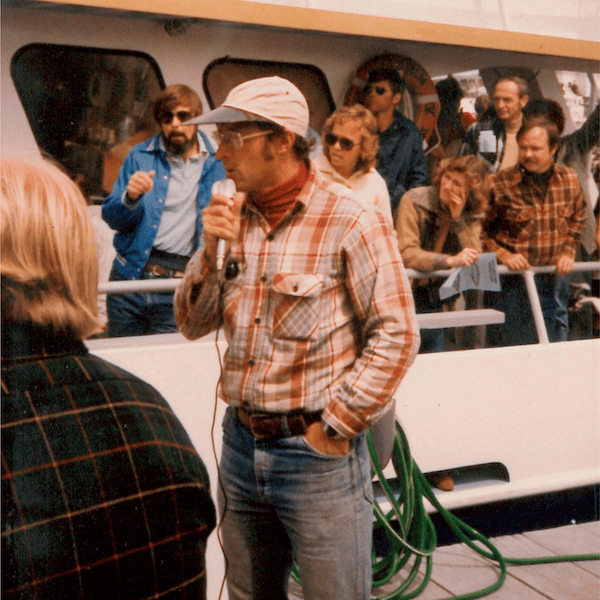
Charles “Stormy” Mayo speaks to passengers aboard a Dolphin Fleet Whale Watch vessel. Acting as onboard naturalists, CCS researchers shared the science and mystery of whales with generations of whale watchers while gaining invaluable time on the water for field observation and research.
CCS also creates pathways into the field. Students, interns, and early-career researchers work alongside experienced scientists, contributing to ongoing studies while developing their own areas of interest. This emphasis on mentorship and hands-on experience has helped launch the careers of scientists working around the world today.
The work extends beyond CCS through partnerships with research institutions, government agencies, and nonprofit organizations, connecting local science with broader regional, national, and international efforts.
At the same time, CCS works closely with coastal communities. Partnerships with fishermen, collaboration with local officials, and engagement with property owners and resource managers ensure that research is informed by lived experience and supports real-world decision-making.
This reflects a core value of the Center for Coastal Studies: the oceans and coasts belong to everyone, and science plays an essential role in caring for the marine environment and connecting people to it.

CCS Marine Fisheries Research Director Owen Nichols dissecting a diamond squid with students in the Dominican Republic.
My time at the Center helped me be a very good observer and a better researcher. We’re always learning. That was really a gift for me, working with people who are so excited, passionate and committed about what they do.
— Carol “Krill” Carson, Marine Biologist
Understanding the Lives of Large Whales
WHAT LONG-TERM OBSERVATION MAKES POSSIBLE

Individual humpback whales can be identified by the unique patterns on their flukes and dorsal fins. Above: Nile, frequently observed in local waters and pictured here with her 2026 calf; Right: Salt, the first named humpback whale; and Ibis, the first whale successfully disentangled by CCS in 1984.
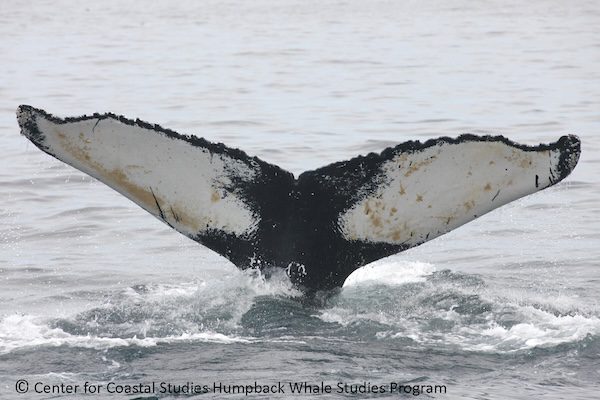
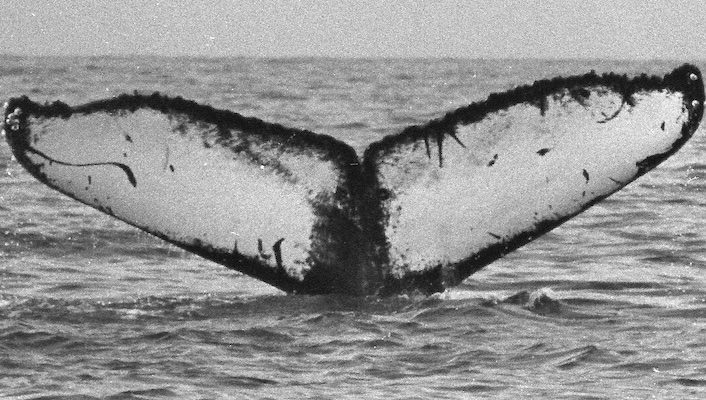
Fifty years ago, much of what scientists understood about large whales came from the study of animals killed through commercial whaling. Far less was known about the lives of living whales, including their migration patterns, habitat use, family relationships, behavior, longevity, and the threats they faced.
Whale research has been central to the Center for Coastal Studies from the beginning. Early CCS research helped reshape scientific understanding of whale populations through the use of photo-identification techniques for humpback, fin, and right whales, making it possible to recognize individual animals over time. This approach, carried out year after year, has revealed population dynamics and provided unprecedented insights into the life histories of these marine mammals.
Long-term datasets have revealed multi-generational family histories and patterns of site fidelity, with humpbacks returning throughout their lives to the areas they first visited as calves.
Today, CCS maintains the Gulf of Maine Humpback Whale Catalog, one of the world’s longest-running records of an individual whale population and an invaluable scientific resource for understanding and protecting humpback whales and the habitats they depend on.
While advanced technologies including genetic analysis, drone imaging, and satellite tracking continue to expand understanding of whales and their environment, much of this work still relies on the same fundamental approach developed decades ago: observing and documenting individual whales throughout their lives.
Nauset, EgNo 2413, with her 2021 calf in Cape Cod Bay.
CCS Image, NOAA permit #19315-01
Decades of field research have established Cape Cod Bay as critical seasonal habitat for North Atlantic right whales and contributed to management approaches designed to reduce ship strikes and entanglement while minimizing impacts on fishing communities and the maritime economy.
In 2007, years of whale sightings and habitat use data collected by CCS researchers helped support the rerouting of shipping lanes into the Port of Boston. The shift moved vessel traffic away from observed areas of right whale aggregation on Stellwagen Bank, reducing the risk of deadly ship strikes and demonstrating how long-term field research can inform real-world decisions.
Marine Animal Entanglement Response: A New Field of Conservation
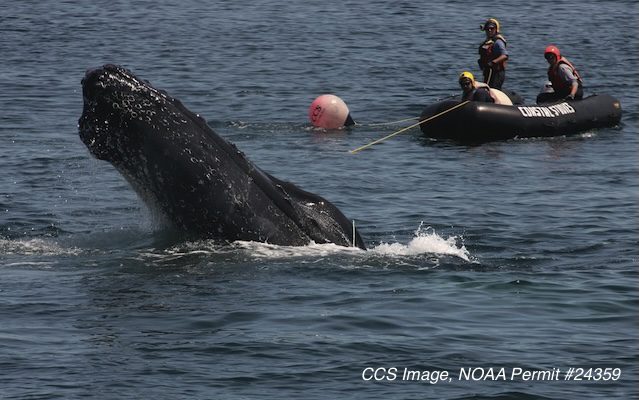
1984: CCS Responders Free Ibis
“We didn’t see entangled whales that often. We didn’t think it was that big a deal.
Then we saw Ibis. Everybody knew this whale. She was very curious around the boats.
What could you do about a free-swimming whale? Stormy started talking with his dad, who said, ‘Why don’t you just keg them like they did in the old days?’ You’d add a rope with buoys on it until you could tire them out and haul them in.
We were very fortunate with the first one. From there we learned to do it much more safely and systematically.”
— David Mattila, CCS Scientist Emeritus
Innovation Through Experience
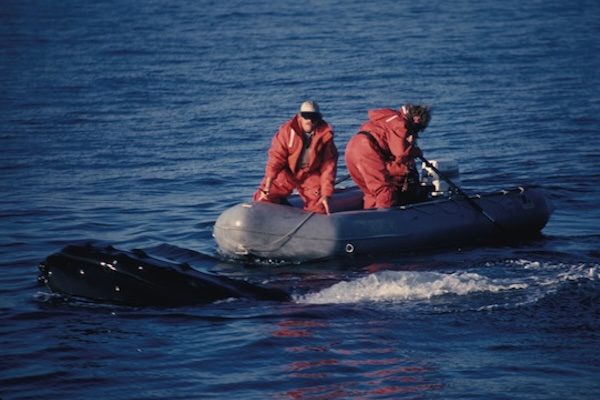
Hours on the water, careful study of individual entanglements, and a willingness to experiment helped CCS develop many of the tools and methods now considered best practices in large whale disentanglement. To date, CCS has successfully disentangled more than 300 whales and sea turtles.
CCS responders work to disentangle the humpback whale Bounce in July 2024.
Sharing Disentanglement Tools and Techniques Worldwide
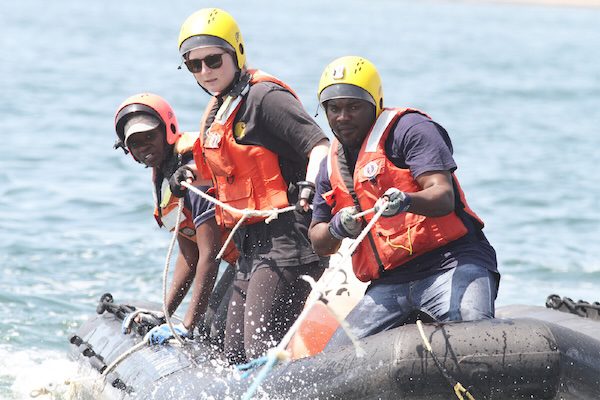
Through the Global Whale Entanglement Response Network (GWERN) and other international collaborations, Center for Coastal Studies has trained more than 1,500 responders from 43 countries in disentanglement tools, techniques, and safety practices developed in Provincetown.
CCS MAER staff conduct a disentanglement training exercise with responders from Kenya in Provincetown Harbor.
Studying Systems Over Time
A lot of science is comparison. You collect information on the basic characteristics of things, and then look at changes. You can’t answer questions about changes in water quality, changes in habitat use by whales and other species, if you can’t find out what you had before.
Connections are hard to make over short periods of time. It’s always a case of establishing baseline data and monitoring, to understand how things have an impact. — Stormy Mayo
Graham Giese documents shoreline erosion at Newcomb Hollow Beach in 2017.
One of the guiding ideas behind the Center for Coastal Studies from its inception was the recognition that marine and coastal environments function as interconnected systems, and that studying those systems requires sustained observation. Across fifty years of research, CCS scientists have returned again and again to the same shorelines, waters, habitats, and species to understand how they change and how those changes affect both ecosystems and human communities.
As new environmental questions have emerged, CCS research has evolved to meet them. Long-term studies of shoreline change and sediment transport expanded into research on coastal flooding, sea level rise, salt marsh restoration, and shifting topography. Early benthic biodiversity studies grew into broader ecosystem assessments and global collaborations such as SeagrassNet, a global seagrass monitoring program. Water quality monitoring in Cape Cod Bay and surrounding embayments helps communities understand the impacts of development, changing environmental conditions, and human activity on marine ecosystems and public health.
CCS research combines field observation, mapping, monitoring, and collaboration across disciplines to better understand how coastal systems function over time and how communities can respond to a changing coast.
From Research to Real-World Actions

1992: Stellwagen Bank National Marine Sanctuary
Nominated for sanctuary status by the Center for Coastal Studies in 1982, Stellwagen Bank National Marine Sanctuary became one of only thirteen national marine sanctuaries in the country in 1992, following a decade-long federal review process.
CCS scientists had long recognized Stellwagen Bank and surrounding waters as one of the most biologically productive marine habitats in the Gulf of Maine and an area essential to whales, seabirds, fish, and other marine life. The sanctuary’s establishment reflected decades of scientific observation and a growing recognition of the importance of protecting key marine environments and the species that depend on them.
Map courtesy of NOAA/Stellwagen Bank National Marine Sanctuary
Understanding change. Protecting marine life. Building resilience.
Water Quality and Coastal Health
Concerns about water quality have shaped CCS research for decades. In the 1980s and 1990s, CCS scientists helped study potential ecosystem impacts associated with major regional developments including the Massachusetts Water Resources Authority outfall pipe and thermal discharge from the Pilgrim Nuclear Power Plant. Monitoring efforts in Cape Cod Bay and surrounding coastal waters established critical baseline datasets and helped researchers better understand how pollution, warming waters, changing currents, and nutrient runoff affect coastal ecosystems and communities.
Today, CCS scientists and volunteers continue monitoring coastal embayments, estuaries, rivers, ponds and offshore waters throughout the region. Areas of study include:
- Tracking water quality before and after habitat restoration efforts to help evaluate ecosystem health
- Hypoxia events associated with die-offs of commercially important marine species
- Harmful marine algal blooms that can threaten human health, shellfish, and marine ecosystems
- Eutrophication and habitat degradation driven by nutrient and wastewater pollution
Together, these long-term datasets help scientists better understand how environmental and human-driven changes impact marine ecosystems, help inform resource management decisions, and support resilience in coastal communities.

Water Quality Monitoring staff conducting sampling on Cape Cod Bay
The Work Ahead
For fifty years, the Center for Coastal Studies has evolved in response to new scientific questions, environmental pressures, and a changing coast. Today, CCS scientists continue to work alongside educators, research partners, management agencies, and community members to better understand and protect marine and coastal ecosystems.
The challenges facing coastal environments continue to grow in scale and complexity. CCS research, monitoring, education, and public engagement efforts help people respond to these changes while fostering deeper connections with the marine environment.
Initiatives such as the CCS Marine Debris & Plastics Program, a regional leader in addressing the growing impacts of marine debris on beaches and in coastal waters, reflect CCS’s ability to adapt scientific expertise and field experience to a changing marine environment.
Education and public participation remain central to this work. Through partnerships, field programs, outreach, and collaborations on the water, CCS continues to create opportunities for people to participate in and learn from the science shaping the future of our coasts and oceans.
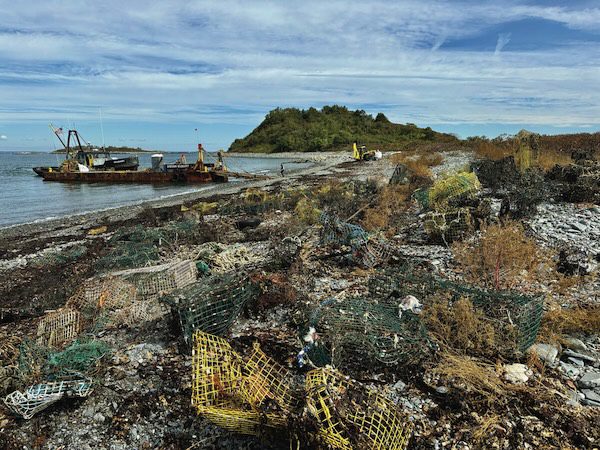
This image, taken on Great Brewster Island during a multi-day cleanup effort across the Boston Harbor Islands in September 2024, shows a portion of the more than 12 tons of debris removed from sensitive coastal habitats through a collaborative effort involving volunteers, partner organizations, artists, and government agencies.
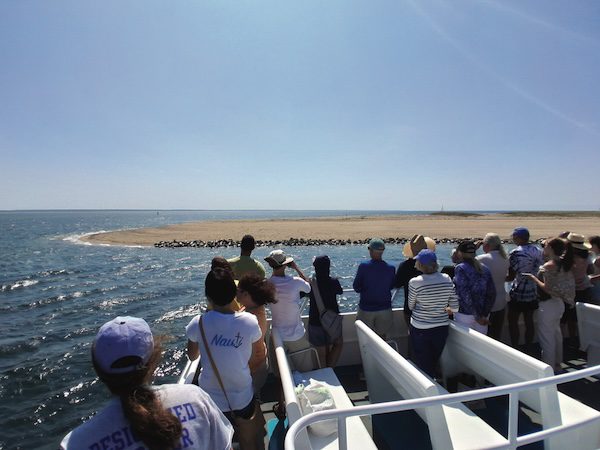
CCS has recently expanded its partnership with the Dolphin Fleet Whale Watch to offer programs including Science in the Harbor cruises, which connect the public with ongoing research into the wildlife and ecology of Provincetown harbor. Here, passengers observe seals hauled out at Long Point.