
Tanned from a summer of volunteer work on the water, and wearing Center for Coastal Studies T-shirts and zip-up sweatshirts, Barbara Brennessel and Nick Picariello meet Jenn Burkhardt, a researcher from the Center’s Water Quality Monitoring Program, at the dock in Wellfleet Harbor. It’s ten-o’clock on an early September morning, the sun is out and there’s a warm breeze. It’s time to test the water quality in Wellfleet Bay.
In a well-practiced routine, Barbara and Jenn take seats in the stern while Nick maneuvers the boat into the calm bay. Nick knows exactly where he’s going without having to consult his GPS, having repeated the same trip about ten times each year for past five or six years.
They try to limit testing to nice days. “Still, the winds can be fickle,” says Nick.
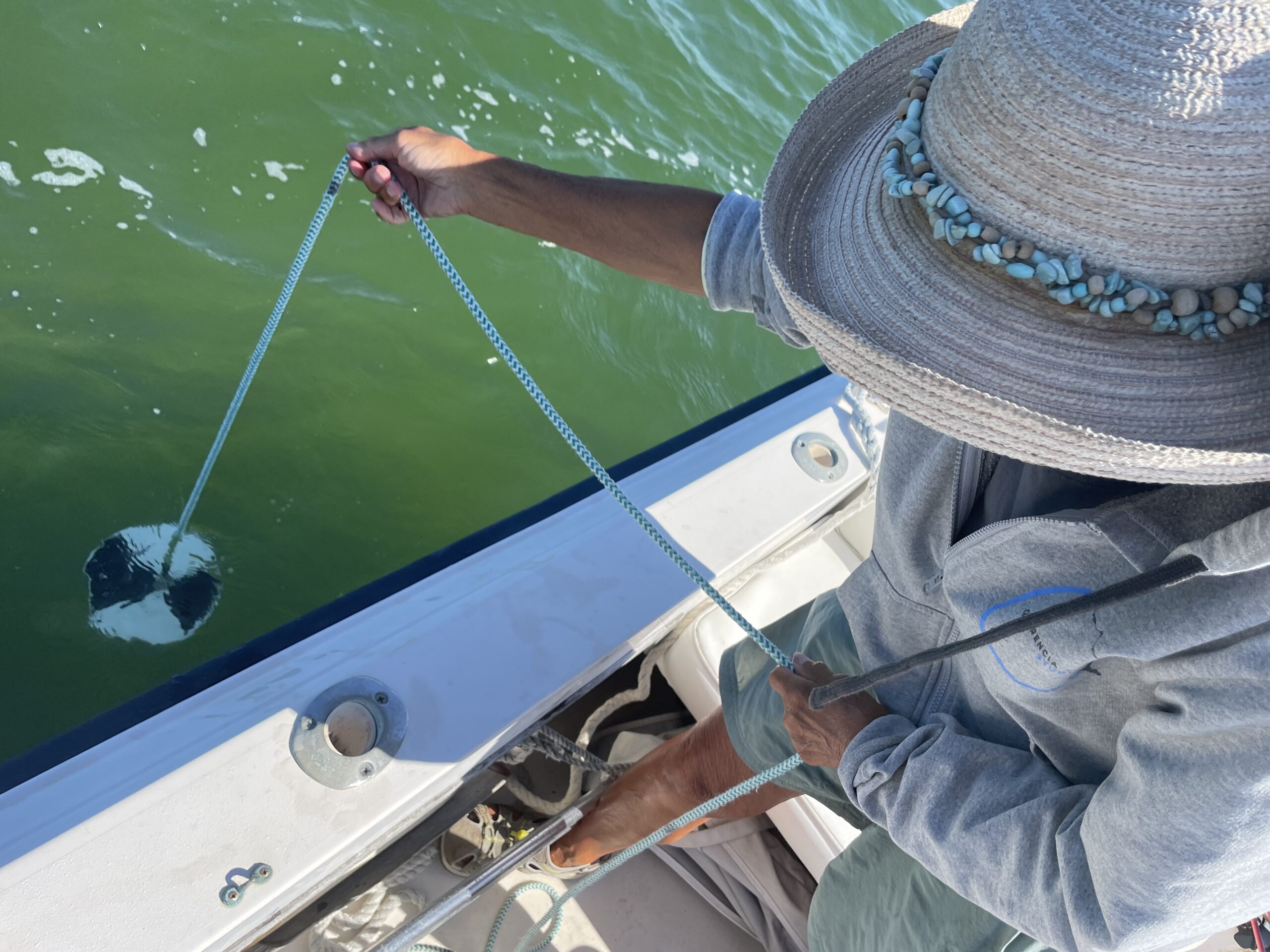
He opens up the throttle and speeds to the first sampling site. Once there, Barbara, on the starboard side, scoops a brown plastic bottle over the side to take a surface sample, and then deploys a Secchi disk, which measures the water’s turbidity.
On the port side, Jenn deploys the YSI, an electronic sensor that measures salinity, dissolved oxygen, and temperature. That done, she sets up a Niskin bottle and lowers it over the side. When it has descended to two meters, she releases a lead weight which closes the tube, collecting the water sample at the desired depth. Jenn pulls the sample to the surface, where Barbara is waiting with an empty bottle.
Nick and Barbara are part of a Center for Coastal Studies’ network of citizen scientists who monitor and protect Cape Cod’s waters. All together, they along with CCS staff and partnering environmental organizations, collect samples from 120 stations across Cape Cod Bay, Nantucket Sound, and local embayments, working from boats as well as from shore.
The samples are sent to CCS’s water quality lab in Provincetown for testing. In addition, the lab processes samples from other organizations, such as the Association to Preserve  Cape Cod, whose volunteers collect samples from 50 ponds across the Cape.
 The work is important because water is the foundation of Cape Cod’s coastal ecosystem, an ecologically rich network of marine habitats that support a wide range of plant and animal life, including marine mammals, sea turtles, birds, fish, and shellfish. These habitats are under increasing pressure from threats that include pollution, eutrophication (excess nutrients fueling plant and algae growth), and hypoxia (low oxygen).
The data that Nick and Barbara collect is ultimately posted to a website called www.capecodbay-monitor.org, where towns, agencies, and researchers use it to track conditions and inform decisions.
Their involvement with the Center for Coastal Studies began when Barbara volunteered to work as a “picker” in the lab, that is, analyzing microscopic organisms collected on the seafloor. She also volunteers in the Center’s Marine Invader Monitoring and Information Collaborative Program (MIMIC). One thing led to another, and soon she and Nick were collecting water samples. The work comes easily to her. Barbara is a retired professor of biology, and taught at Tulane University, and later at Wheaton College.
 “During my career, I was stuck in a lab all day, this is so much better,” she says.
Nick is a retired physician, and jumped at the opportunity to spend more time in his boat.
“What’s not to like about this?” he asks. “This for me is just fun, but I enjoy the scientific aspect too.”
Nick and Barbara are active volunteers. In addition to their work with the Center, they do horseshoe crab spawning surveys for the Department of Marine Fisheries, and Barbara researches diamondback terrapin turtles for Audubon. In the winter they both patrol the beaches for cold-stunned Kemp Ridley, green and loggerhead turtles.
Their efforts have been a great help to the Center’s Water Quality Monitoring Program. Prior to their involvement, staff at CCS had to trailer a boat to Wellfleet Harbor and launch it every time they took samples, while Barbara and Nick’s motorboat is conveniently located at the town pier.
They conduct their research twice a month June through September, and once a month in May and October. Each time, they visit nine sampling sites. Each trip lasts about an hour.
 “Wellfleet harbor is polluted with nitrogen and the town is charged by the state to clean it up. The Target Watershed Plan, that’s based on the numbers being presented, is currently being reviewed by the state. This is vital. Don’t you agree Barbara?” asks Nick.
“Oh yes, I echo everything you just said,” agrees Barbara.
Shortly before taking their final samples, a Mola mola, or ocean sunfish, jumps clear of the water and lands with a big splash, as if to remind us of the nature that surrounds us, and the importance of taking care of the bay.
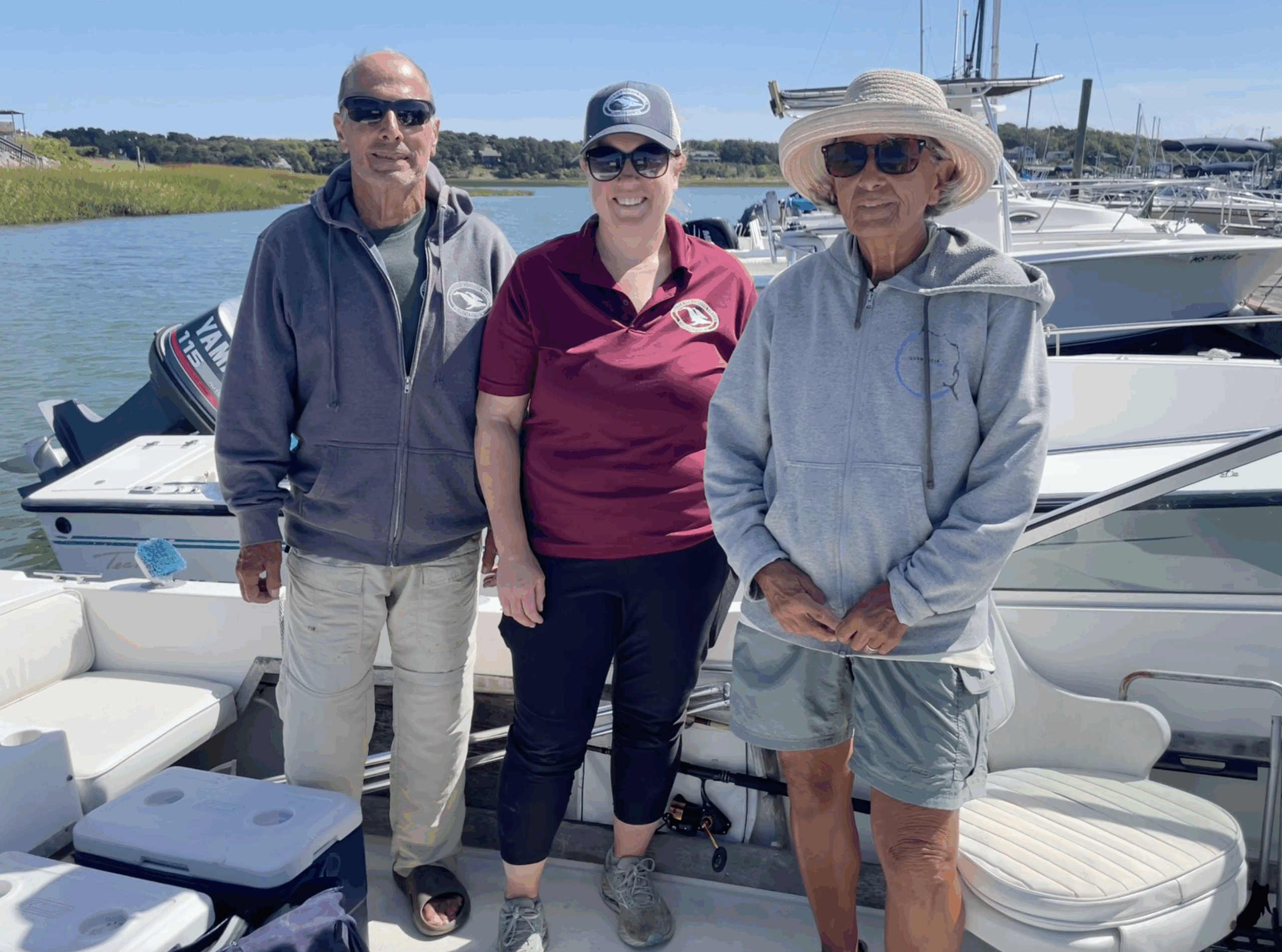
Photos top to bottom: Barbara and Jenn sit in the stern as the boat speeds to a sampling site; Barbara records data from the Secchi disk; Nick at the helm; The YSI measures critical information like dissolved oxygen and temperature; Jenn deploys the Niskin bottle; the Secchi disk measures turbidity; Nick, Jenn and Barbara back at the dock.