The following was recently published in the current issue of Coastwatch, the Center for Coastal Studies’ annual publication:
Forty years ago, on Thanksgiving Day, 1984, Charles “Stormy” Mayo and David Mattila of the Center for Coastal Studies (CCS) performed their first-ever successful whale disentanglement. The whale was a humpback called Ibis.
Ibis had been observed many times by CCS researchers. Stormy Mayo, who named the whale based on a mark resembling the Egyptian hieroglyph, said, “She was an old friend, I knew her well.”
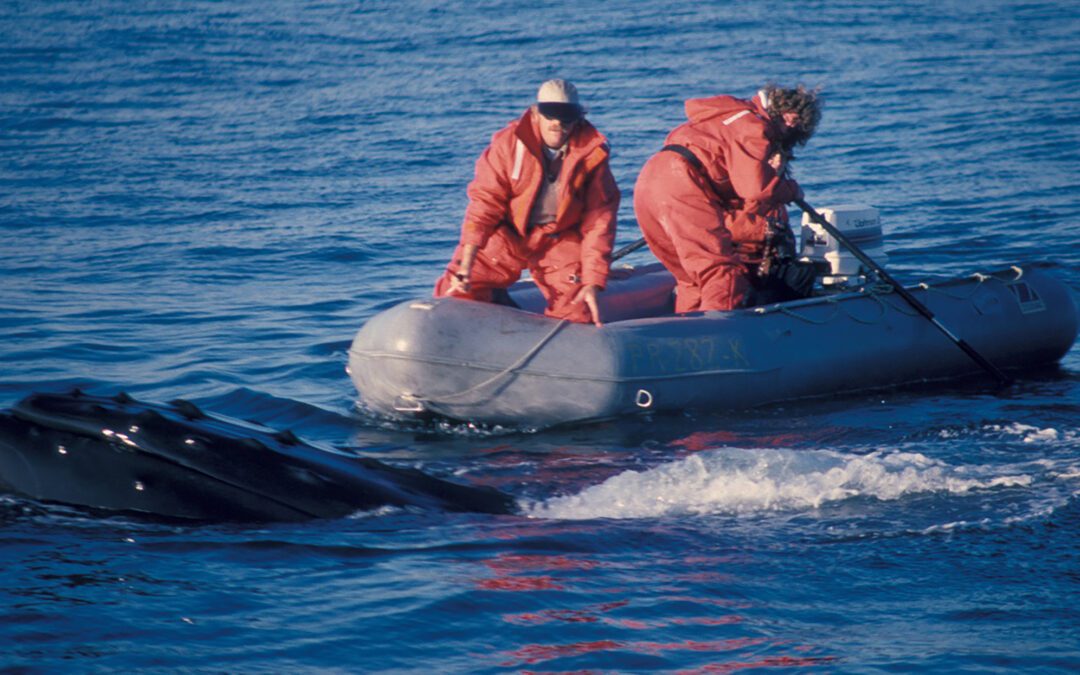
Just a month or so earlier, Stormy and Carole “Krill” Carlson, an assistant scientist at the time, had attempted a rescue of Ibis while she was “anchored” off Gloucester Harbor. It appeared that the gill net Ibis had been dragging for months had become tangled in something on the bottom. The tide was rising. Ibis was struggling to break the surface to get air. Stormy and Carole hooked on several floats to try to help her stay on the surface, but the weight pulling her down was too great, and she remained submerged. The crew returned home to Provincetown, convinced Ibis was dead.
Late in the morning on Thanksgiving Day, Stormy and David, accompanied by Stormy’s dad, Charlie, Mary Pratt-Havermale, Sharon Pittman, Mark Gilmore, and Carole “Krill” Carson, headed into Cape Cod Bay aboard the R/V Halos to record whale acoustics near Long Point.
“Lo and behold, there was Ibis,” recalled Stormy. Seeing that she was still entangled, Stormy and David clambered into inflatable boats.
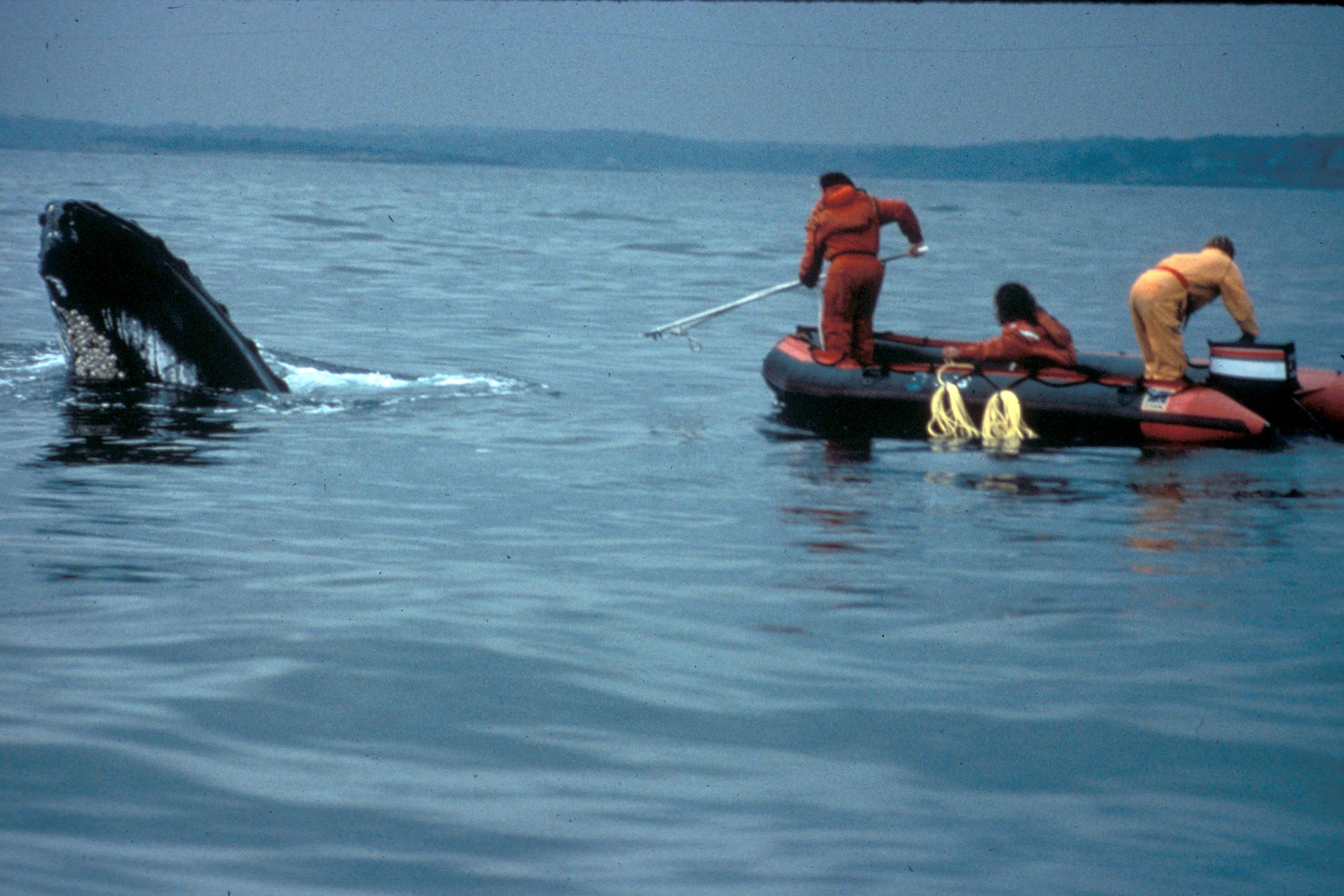
“This was before we had a disentanglement system,” said Stormy. Improvising, David suggested that they throw a grapple anchor tied to large plastic floats into the tangled net. This technique to add flotation to the entanglement is adapted from a whaling technique known as “kegging,” and is now a fundamental tactic in whale rescue.
While working on the tangled net, Stormy noticed that Ibis had a deep gash on her tail stock. He wondered if she had enough blubber to survive, as she wouldn’t have been able to feed for months. He reached down and touched the wound, and Ibis started to bleed. For Stormy, the moment was an epiphany, speaking to the relationship between man and whale. “It was a sign that she feels. This is a living breathing creature. She’s one of us, she’s suffering.”
After four hours of exhausting and dangerous work, Ibis was free of her entanglement. “The last view I had was Ibis and another whale swimming north, diving, tails up,” said Stormy.
It had been a long day, and the rescuers had missed their Thanksgiving feasts. Upon hearing this, the next day, Napi Van Dereck, owner of Napi’s Restaurant, hosted the entire crew to a lavish Thanksgiving feast at the restaurant!
The next spring, on a whale watch boat, the crew watched as Ibis, alive and healing well from her ordeal, breaching and swimming on Stellwagen Bank.
Photo above: David Mattila, Sharon Pittman, and Mary Pratt-Havermale during the Thanksgiving Day disentanglement of Ibis. Photo below: Stormy Mayo, Carole Carlson, and Mike Williamson during their first, unsuccessful attempt to free Ibis off Gloucester.