
Over the millennia, Duck Harbor in Wellfleet has been a marsh, a harbor, and a forest. After an ongoing series of naturally occurring overwashes, it’s now turning back into a marsh. Researchers at the Center for Coastal Studies are looking to Duck Harbor to better understand how the sea and the land interact and how our coasts evolve.
Duck Harbor is a geologically unusual situation. Overwashes usually build elevation through depositing sand and sediment, which prevents further overwashing. That’s not the case in Duck Harbor, where it’s theorized that gravel prevents sand buildup, and thus encourages repeated overwashes. That makes it a valuable place for geologists, who can study it to better understand how coastal ecosystems evolve over time, and the effects of overwashes on coastal vegetation.
In the summer of 2023, Dr. Katie Castagno, Director of the Center for Coastal Studies’ Land-Sea Interaction Program, and her team took a series of test cores throughout the area and used the results to create a 3-D model of the area, indicating deposits of peat, sand, clay, and shells in the six feet below the surface. Based on those results, in the summer of 2024, using a vibracore, a high-frequency-low-amplitude vibrating device that allows core tubes to penetrate into sediment, she took five deeper, strategically-located core samples. Castagno explained that the cores will reveal how the location has changed over the last 1000 years or so.
The cores are contained in 6-foot aluminum tubes, and stored in a refrigerator to preserve them. On a recent afternoon, Castagno and research assistant Abby Geise carefully cut them open to reveal the layers of sediment inside. They weren’t disappointed.
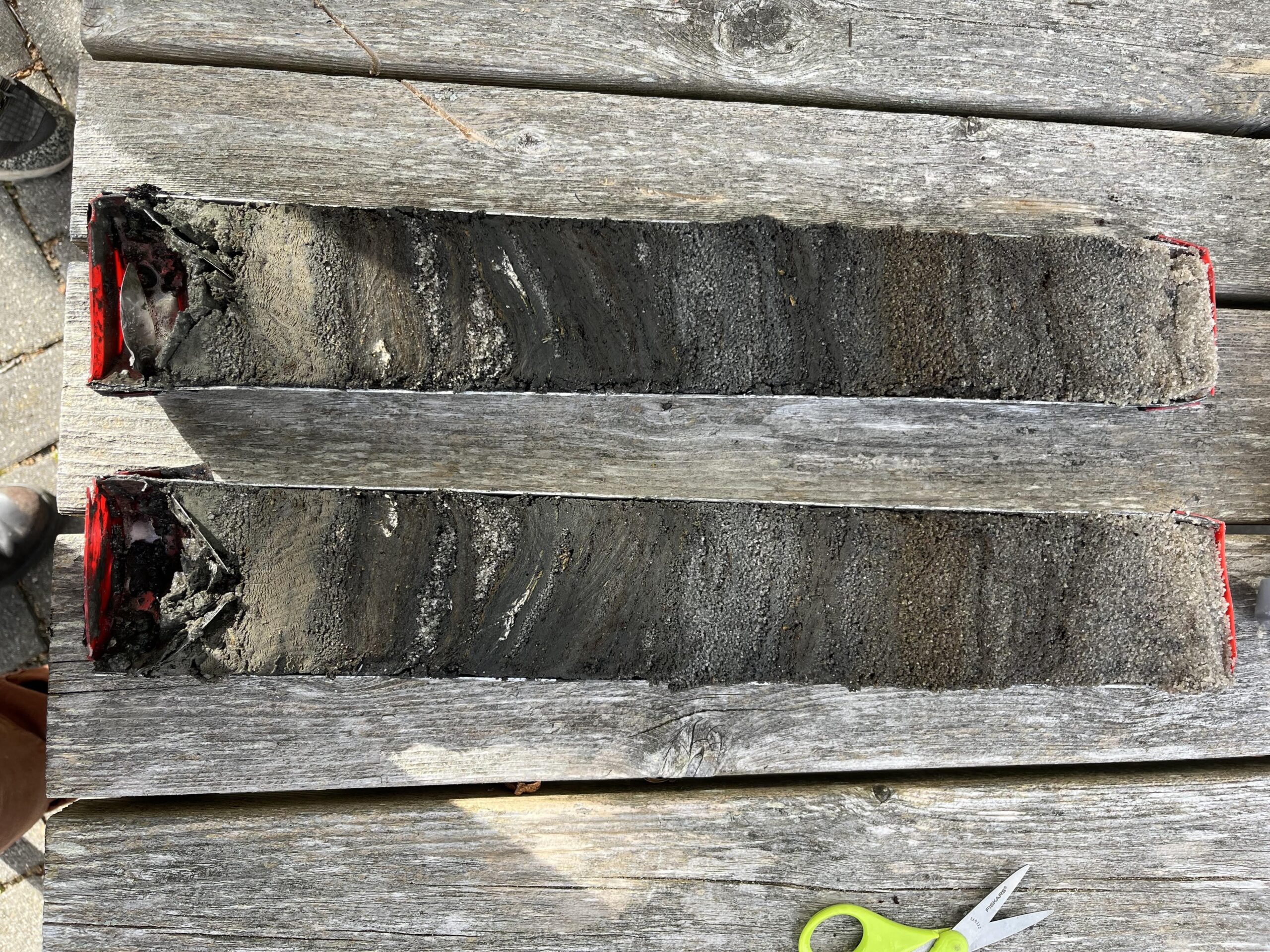
“These cores look even cooler than I thought they would. They show us how things have changed in the past and provide a better understanding of why it is like it is today. It’s incredible,” said Castagno.
To analyze the cores, Castagno is sending organic material to Woods Hole Oceanographic Institution for radiocarbon dating. She will also send samples to Northeastern University to measure levels of Cesium-137 isotopes, which indicate nuclear activity and help date more recent sediment. (Radiation levels can be traced to atmospheric and underwater nuclear testing, banned in 1963.)
The core samples taken in Duck Harbor will inform restoration efforts in the nearby Herring River restoration project, the largest tidal restoration project in New England. For example, it will show the historical effect of salt water inundation on woodlands, and how the system will change when dams are removed and salt water is reintroduced, as well as the impact of increased storms possibly caused by climate change.
While the analysis is yet to be completed, Castagno is optimistic that the cores will provide useful insights into the coastal environment.
“By understanding the past, we’re better prepared to understand what will happen in the future, and how our coastline will evolve in the years to come,” she said.
Photo at top: Research Assistant Abby Geise prepares to cut open aluminum cores to the layers of sediment inside.