
Between the months of March and May, the trap fisheries of Massachusetts make way for North Atlantic right whales by removing their gear from the water. Each spring, individuals of the endangered right whale population come to these waters in search of foraging opportunities. As the plankton populations explode, Cape Cod Bay provides enough nourishment to sustain these large marine mammals. Besides the right whales, the CCS Marine Debris and Plastics program and Marine Fisheries Research program also move into the Bay, seizing the opportunity to recover “ghost gear” (lost or abandoned fishing gear) that degrades habitat and adds plastic to the marine environment. This spring, members of both programs have worked with Provincetown lobsterman Mike Rego to recover nearly 200 lobster traps and heaps of rope, gillnet, trawl net, steel cable and other mysterious debris from the Bay.

So far we have completed eight days of work on the water. Each morning we arrive at Provincetown’s MacMillan Pier and board Rego’s boat, the F/V Miss Lilly, with our foul weather gear, data sheets, GPS, and camera. At the beginning of the fisheries closure, scientists from CCS conduct side scan sonar imaging in areas where fishermen suspect gear has been lost. Based on these scans, we are able to determine where to grapple for the lost and abandoned gear. The grapple is a metal hooked tool that is attached to a rope and the hauler on the side of a lobster boat. By dragging the grapple along the muddy and sandy seafloor of the Bay, we are able to snag foreign objects and then haul them up to the deck. Once the debris or trap is above the water’s surface, we can pull it aboard and start collecting our data. Often when a trap has been lost since the early 2000’s (or even before then) it will be partially buried in the mud or crushed by a dragger. No matter the trap’s condition, we often have to release organisms that are stuck in or on the traps back into the sea. Cunner, tautog, blue mussels, anemones, Jonah crabs, rock crabs, green crabs and lobsters are among the most common organisms we find in the traps. We record whatever is in the traps, and release the organisms back to the sea before collecting other pertinent data.
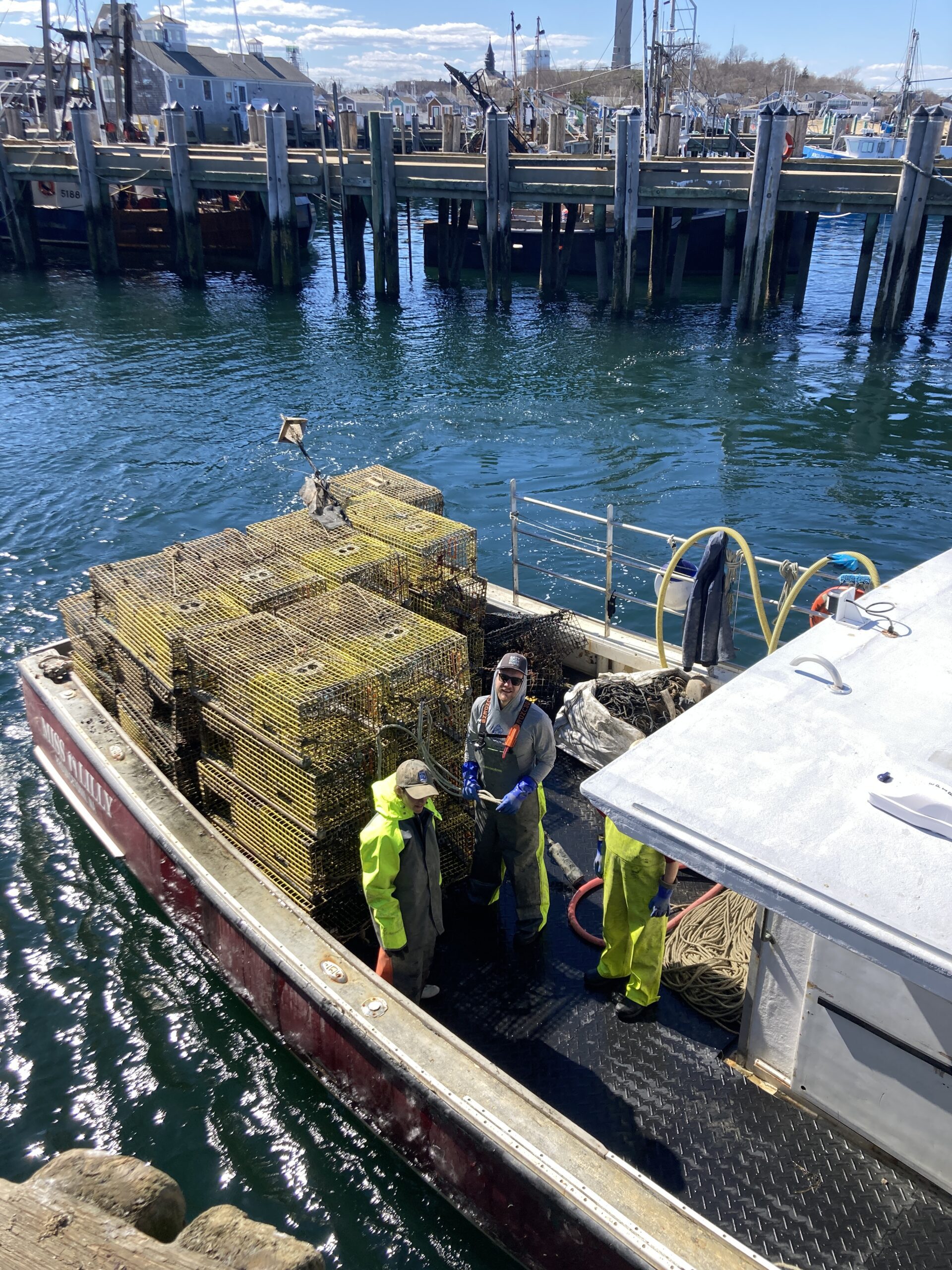
Once the traps have been cleaned out (mud, sand, organisms) we take pictures of three sides of the trap. These data help us later to digitally understand the volume of each trap. Next, we look for permit tags and other tags that might tell us more about the trap. We look for the most recent year listed on permit tags, the permit number and any personal information about the fisherman (name, phone number, etc.). We make commentary about the state of the trap, whether it was associated with any rope or other debris, and finally, we stack the traps at the back of the boat to make room on the deck for the next load. In addition to the trap data and biological data, we also note the depth of the area where we found the debris, the coordinates of the location where we encountered the debris, how long the grapple was in the water before encountering the debris, and the length of the grappling line that is extended behind the boat.
Out on the boat, we often find that our days move quickly, with temporary lulls as we wait with anticipation for the next snag. Similar to fishing, we must await the catch, even with the knowledge of the traps’ presence. On our most productive day we hauled in 42 lobster traps and piles of rope and net. On our least fruitful day we brought in 12 traps and much smaller piles of rope and net. Regardless of our effort, some days produce more of a haul than others, which is part of the mystery and excitement of leaving the harbor each morning– never knowing what we might find and what debris we might eliminate from this essential habitat.
– Wilson Haims