PROVINCETOWN, MA – During an aerial survey yesterday, Monday, Nov. 18, scientists from the Center for Coastal Studies (CCS) Right Whale Ecology Program observed two endangered North Atlantic right whales in Cape Cod Bay. It is the first such sighting of the 2024-2025 field season.
One whale was located less than a mile east of Pilgrim Beach, Plymouth, while the other was sighted on the other side of Cape Cod Bay, seven miles west of Wellfleet. After collecting photo-identification, the aerial observers notified the team aboard the CCS research vessel Shearwater, so that they could sample the zooplankton patch the whale off Pilgrim Beach was feeding upon.
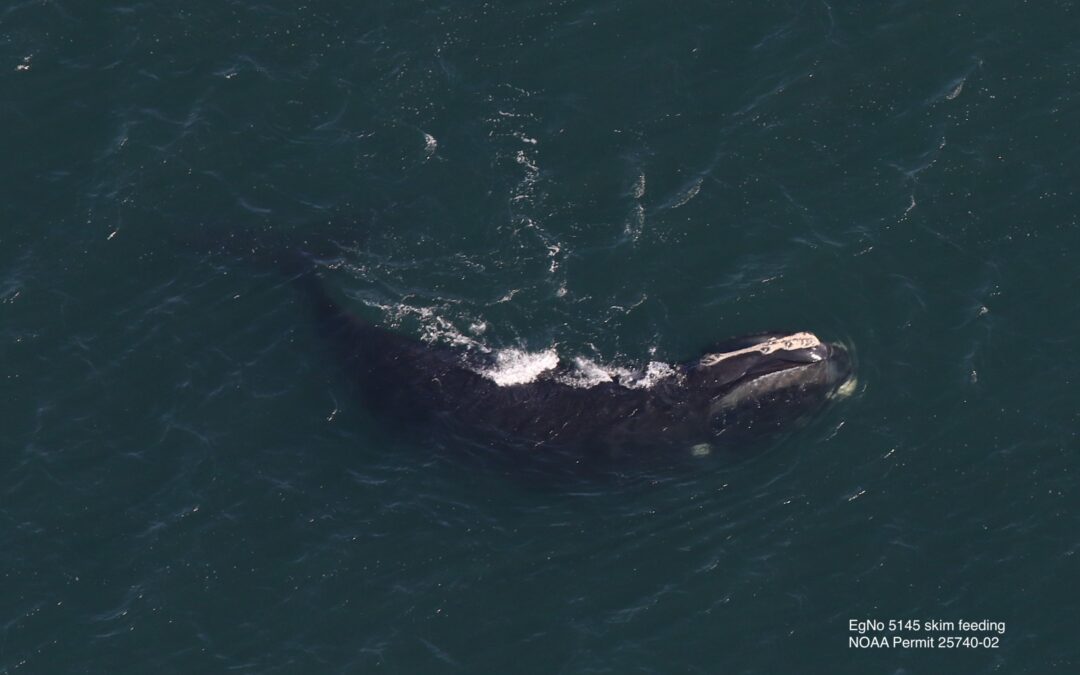
The whales were identified to be two juvenile males; a four-year-old (catalog #5023) and a three-year-old (#5145), which has been observed in Cape Cod Bay every year for the last three years, including as recently as April 2024. The three-year-old was observed skim feeding, or feeding on zooplankton near the surface of the water. Such behavior is usually not observed until much later in the season.
“It is normal to have right whales popping in and out of the bay throughout the year; however, it is surprising to see skim feeding in the fall,” CCS researcher Christy Hudak explained.
Based on the plankton samples collected in the path of the skim-feeding right whale yesterday, the zooplankton patch contained a combination of their three favorite copepods or microscopic crustaceans, including the oil-rich Calanus finmarchicus.
According to Hudak, “Although Calanus was not the dominant species in the sample, its presence in higher numbers is unusual for this time of year and it will be exciting to see if the food resource this year will prove a banner season for right whales in Cape Cod Bay.”
North Atlantic right whales are a critically endangered species, with a total population estimated at just 372, only 70 of whom are breeding females. They typically arrive in Cape Cod Bay in early winter with many residing in the area into mid-May. Last year, nearly half the North Atlantic right whale population was observed in Cape Cod Bay, whose protected waters provide an important source of the zooplankton on which they feed.
Currently, seasonal protections for North Atlantic right whales are not yet in place, so boaters should be aware that there are whales in the area and exercise caution. State regulations that include prohibiting the setting of fixed fishing gear and limiting the speed of vessels to 10 knots go into effect early next year, when right whales arrive in larger numbers in Cape Cod Bay. Ship strikes and entanglement are the leading cause of right whale deaths.
During yesterday’s survey, CCS aerial observers also sighted seven Risso’s dolphins. Risso’s dolphins are usually found in deep, open-ocean waters, which makes sighting them in the relatively shallow waters of Cape Cod Bay an infrequent occurrence. CCS researcher Ryan Schosberg elaborated “we were happy to see all of those animals free-swimming, as they are known to strand when found in Cape Cod Bay.”
Photo at top: North Atlantic right whale EgNo 5145 skim feeding in Cape Cod Bay, Nov. 18, 2024; Photos below: North Atlantic right whale EgNo 5023 swimming in Cape Cod Bay, Nov. 18, 2024; Risso’s Dolphins swimming in Cape Cod Bay, Nov. 18 2024, NOAA Permit 25740-02.


\