February 2, 2022
R/V Shearwater
Today was the first February trip of the season. Before leaving the dock, we received a call telling us there were right whales spotted near Herring Cove. Luckily for us, those whales were still in the area by the time we made our way over there. After observing the few right whales in that area, we continued toward station 6N to try to find some more. Throughout the day, we documented singleton whales, associated whales, including some whales involved in surface active groups (SAGs). I have never seen whales involved in a SAG before, so it was extremely interesting to watch the whales interact with each other in that sort of manner!
The seas were great for cruising today, with the swell height barely being 10 cm. Although the sea height and winds were low, the fog that set in during the late morning into the afternoon caused our visibility to drop from 7 km to 0.5 km at some points. However, despite the fog, we still managed to find between 21-23 individual right whales! I can’t wait to see what we see on our next trip!
Corry
Click on images for a larger view.
-
- Right whale #3745
-

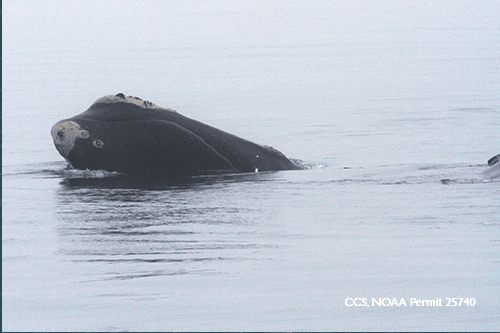
- Right whale #3745

-
- Right whale #2795

-

- Right whale #1409

February 6, 2022
Aerial Survey
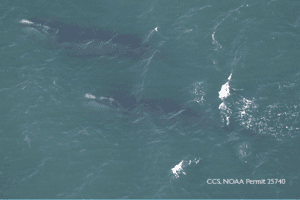
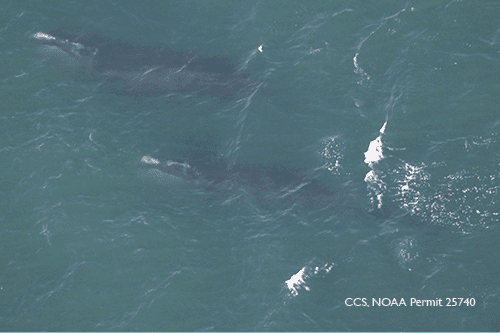
Conditions on Sunday started off as marginal, but luckily improved significantly throughout the day. We conducted an abridged Massachusetts Bay survey concentrated along the shoreline, south to north. After taking off from CQX (PVC was unexpectedly closed), we began our transit through the bay to our first track. Although we were off watch we found 5 right whales shallow subsurface feeding west of Wellfleet. We did not have much time to document, but Ryan did a great job photographing 4 out of the 5.
Two were new for the season, and two we have seen on previous surveys: #3720, #3430 Minus-One, #2413 Nauset and #4903. #4903 is the 2019 calf of #2503 Boomerang, and a juvenile male we last saw in the fall of 2021 south of Nantucket. His callosity has changed quite a lot since November, which isn’t uncommon since he is only 3 years old.
Interestingly enough, the other 3 were all moms last season. Only Minus-One was not seen with her calf in Cape Cod Bay, but we did sight them this past fall south of the islands and documented them.
Once we finished working the whales as well as possible, given the time constraint, we continued to our tracks. We encountered ocean-effect snow and low cloud ceilings, reducing visibility at times, but fortunately it got clear as the day progressed. The survey was quiet except for a lot of fixed fishing gear. There is a seasonal closure in some of the Massachusetts state waters and federal waters, so we were surprised to see so much still present.
We had planned on refueling in Beverly, but that airport, as well as others north of Boston, was closed, forcing us to end our survey earlier than planned. We flew back in beautiful conditions and were slightly disappointed that we did not survey Cape Cod Bay, since there are likely a lot of whales present. Weather looks borderline the rest of the week, but hopefully we can get back up in the near future.
Brigid
-

- Right whales #2413 and 2430 subsurface feeding.

-
- Right whales #2413 and 2430 subsurface feeding.
February 9, 2022
Aerial Survey
Today we had planned a full flight to survey all of Cape Cod Bay. Unfortunately, as our pilots were headed over to pick us up they encountered a charging system failure and had to turn back. Brigid and I waited anxiously on standby at the airport. After a couple of delayed hours, we received the good news that the problem had been identified and solved thanks to our amazing PIC Trevor Laue and they were on their way again to pick us up!
We took off from CQX (as PVC is temporarily closed) and made our way to the southernmost portion of CCB where we started our survey. It was a beautiful day beyond the shore, with clear skies and calm seas. Our first few track lines were pretty quiet, only consisting of a couple of pieces of debris and a few boats. By the time we made our way up to Wellfleet things ramped up quite a bit, as we began seeing our first whales for the day!
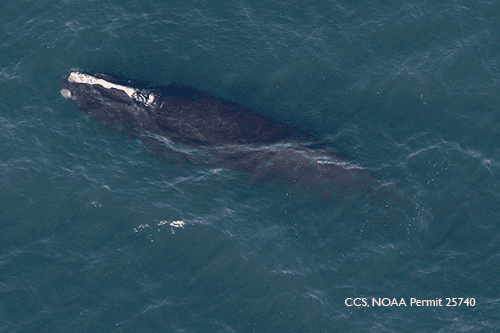
Our first three whales were some well-known individuals, #4040 Chiminea – a female born in 2008 and a mom in 2021, #3840 – a male first seen in 2008 and one of my personal favorites #3530 Ruffian – a male born in 2004. All three of them were happily shallow subsurface feeding.
While documenting these three, we began to see others feeding not too far away and before we knew it, we were up to 14+ whales! Everyone we saw seemed to be subsurface feeding, either alone or co-feeding in groups of three or four, except one: #1017 Batman.
Due to our delayed start, we were fighting against the receding daylight and had to end our survey before we could finish. This was disappointing as we received word that there were 20+ more whales feeding just off of Race Point. We ended our survey having documented a total of 23 right whales, though if we had more daylight we know we could have easily doubled that number. Daylight constraints can be challenging, especially this time of year but we are always grateful to our pilots for always keeping us as safe as possible.
Carolyn
Click on images for a larger view.
-
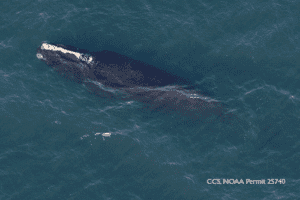
- Right whale #1017
-
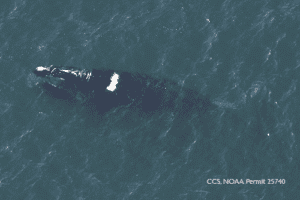
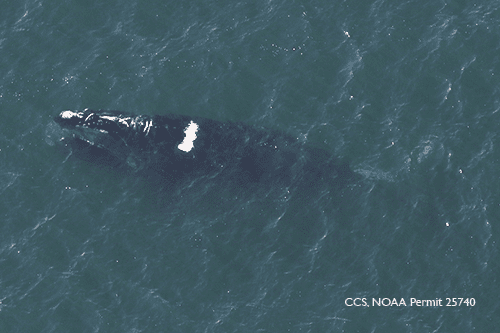
- Right whale #3530
-
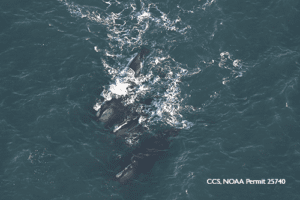
- Right whales #1627, #1409

February 11, 2022
R/V Shearwater
Today we completed our regular 10 sampling stations. The weather started out nice, with low sea heights and winds, but as the trip continued on, the waves and winds both increased. The change in weather made it more difficult to sight whales, but we still managed to spot 13 different right whales! Although today was focused on sampling at stations, we still managed to photograph two individual right whales. The first photographed whale was #4170, is an 11 year-old female. #4170 was observed shallowly skim feeding. Shortly after leaving #4170, we spotted and photographed another right whale, who ended up being the individual #3423, named Epic. Epic is an 18 year old male, and he was observed subsurface feeding. Only a few more distant whales were spotted after Epic’s sighting.
Hopefully on our next trip out we’ll get some closer looks at more individual right whales! I can’t wait to get back on the water soon!
Corry
Click on images for a larger view.
-
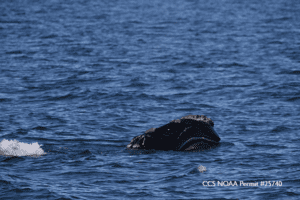
- Right Whale #4170
-
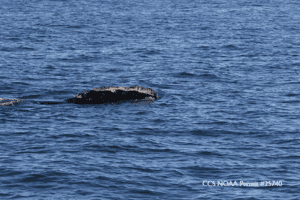
- Right Whale #3423
February 20, 2022
Aerial Survey
The weather kept us grounded for some time, so we were quite anxious to get up for the small weather window on Sunday! Saturday afternoon brought some very strong winds that continued well into the night. Because of this, we decided a late take-off would be best, allowing the seas to calm down a bit. We arrived at CQX and took off close to noon. Today’s survey location southeast of Nantucket, so we had a bit of a longer transit to the area.
When we arrived and started our survey, the sea state was still pretty high, but we knew it would improve throughout the day. A high sea state can make it challenging to spot whales, as every big wave catches our eye. We had hopes of seeing a good number of whales! South of Nantucket is a popular feeding area for right whales.
Unfortunately, our lines proved not only long but sadly quite boring as well. The ocean seemed devoid of life aside from a few dolphins and one seal. Towards the end of our survey we were really excited to see one blow from far out. We quickly went to investigate. The whale had since gone down on a dive, so we stuck around the area searching. After nearly a half an hour, the whale had still not returned to the surface. At that point we had to make a difficult decision to move on and continue with our survey. The rest of our survey was much like the beginning – very quiet.
Although today’s survey proved disappointing, no data is still data! We are all looking forward to another good weather day and anxious to see whales!
Carolyn
February 22, 2022
R/V Shearwater
Click on images for a larger view.
-

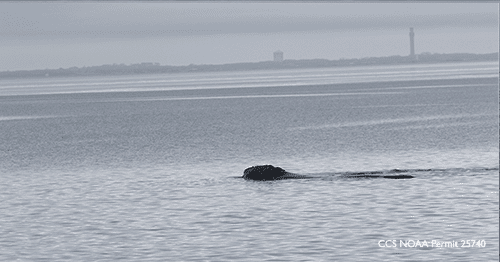
- Whale #3725 with Provincetown skyline in view.
-

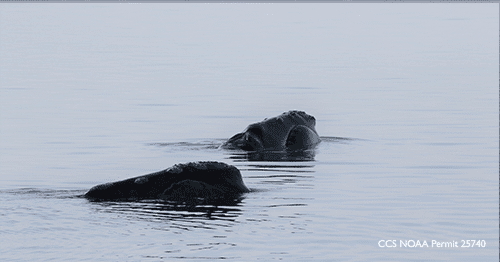
- Whales #2740 & #3020 traveling in Cape Cod Bay
-
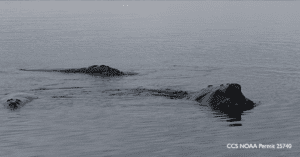
- Whale #3792, #3725, & #2510.

-
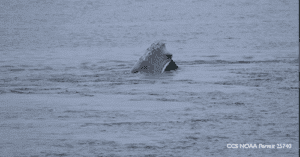
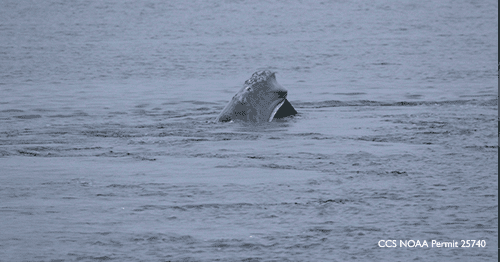
- Whale #4313.
-
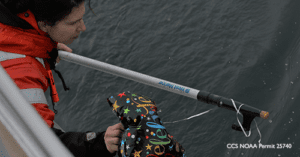
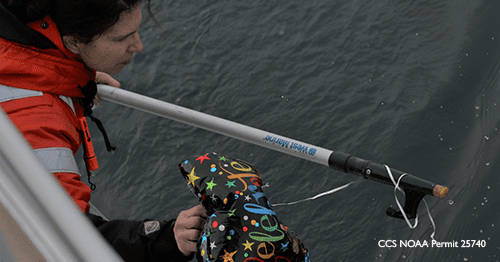
- Christy Hudak removes a balloon from the ocean.
We started off our cruise with beautiful conditions and were excited to see how many right whales we could find! Quickly we spotted a couple individuals off of Herring Cove and headed over there to get a closer look. Soon, we were surrounded by whales in almost every direction. Throughout the morning we followed whale sightings to photograph and document individuals. We were able to get some great photographs of many individuals, including two surface active groups (SAGs), singletons, and a few associated whales. We surveyed a big loop clockwise around the bay, adding in a vertical plankton sample at 6N. On our way back to port, we watched two whales skim feeding in echelon off of Herring Cove and took some fantastic zooplankton samples there.
Although the conditions worsened throughout the day, turning foggy and rainy by the afternoon, our spirits stayed high and we were excited by each sighting. We saw 35 whales and photographed 21, our highest sighting number so far for the 2022 season! I can’t wait to get out on the boat again.
Sarah
February 24, 2022
Aerial Survey
This was our first flight of Cape Cod Bay in almost two weeks and we were optimistic that we would see a high number of individuals since we documented 63 right whales on our last CCB survey. We took off from Provincetown Municipal Airport and started on track line 16 heading south then worked our way north in the bay.
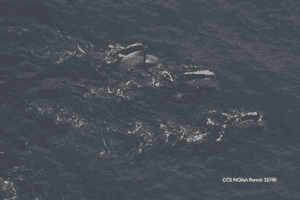
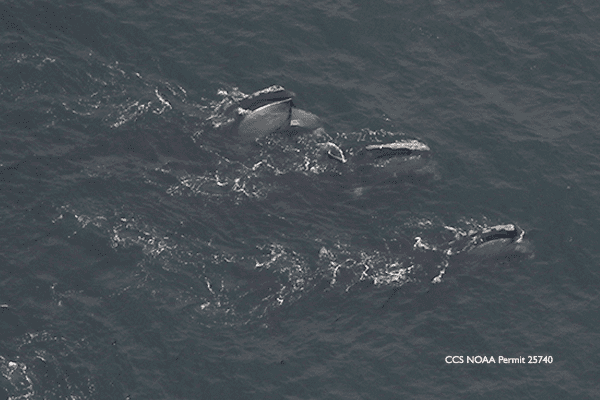
Conditions were decent with overcast skies and sea state ranging between Beaufort 2 and 4. All was quiet in the south, with no sightings until we were on track line 10 off Great Island. There we found two right whales that were difficult to document, so much so that we only managed to photograph one. Things got a little easier as we continued north with us finding lots of feeding whales (including an aggregation of 19!) and a SAG.
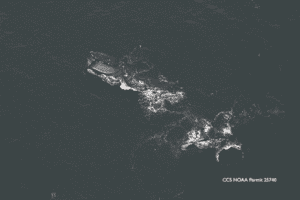
Ryan got great photographs of the sightings, and has matched all of the individuals. There was a mix of new and familiar faces for the season. Familiar included #1701 Aphrodite, an adult female and the focal animal in the SAG. She has been sighted in the bay since mid-January and though she has new entanglement wounds, they seem to be healing. #3823 Sundog and #3942, both of which have been documented since the first week of February, were photographed feeding near each other. The 2019 calf of #3720 was new for us, and was seen coordinated feeding with adult female #4120 and adult male #1820 Cello.
Due to daylight and fuel, we did not get to survey beyond track line 8, but we landed in Provincetown at 15:30 happy that we documented 34 individuals. The season has been picking up faster than in previous years and we are looking forward to the next time we are able to get back up in the air.
Brigid
Click on images for a larger view.
-
- Whale #4120, #1820 & #2019
-
- Whale #3823 & #3942

-

- Whale #3541 & #4714
February 26, 2022
Aerial Survey
Two days ago, on our last (incomplete) flight, we did not make it halfway through the bay and still found over 30 right whales. Today, we started in the northern part of Cape Cod Bay and worked our way south from Provincetown Municipal Airport. All of our guesses for how many we would see were high (max was 70), so even we were surprised when we documented 99 by the end of our 4 hour, unfinished survey.
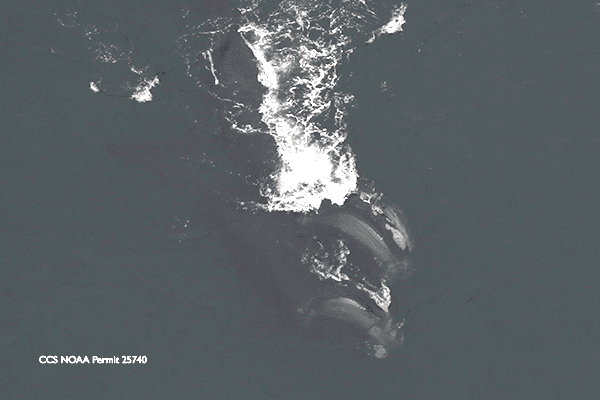
The first right whales of the day were on track line 2, where there was a five whale surface active group (SAG). In the SAG were #4020 Nymph, #2713, #3617 Salem, #3541 and #4650 Sebastian. Sebastian is #3450 Clipper’s only known offspring and named for the Sebastian Inlet where he was brought to as a calf. Unfortunately, Clipper is part of the unusual mortality event and was killed by a probable vessel strike in the Gulf of St Lawrence in 2019.
We continued on our survey and found close to 10 more feeding right whales on tracks 4 and 5. After documenting these whales, we sighted one of two extremely large aggregations, each consisting of close to 30 individuals. The northern aggregation was very difficult to document since they were moving quickly and there weren’t any distinct subgroups to focus on. The other large group on the next track line to the south was more spread out and relatively straightforward to document. Right whales feeding near the surface in aggregations this large is common in the spring during the peak of our season but not in late February. We are curious to find out what may be causing this behavior so early in the season and intrigued by how this season will continue to evolve.
A lot of new individuals were sighted on this flight, including: 2021 mom #2460 Monarch, adult female #2791 Fenway, who our team has not seen since 2018, adult female #3101 Harmonia, adult male #1150 Gemini, and adult male #2705 Silver, who is missing nearly all of his left fluke blade.
We had to head back before finishing again due to daylight and fuel constraints, and are looking forward to hopefully completing a full Cape Cod Bay survey in the near future to get a better idea how many right whales are around.
Brigid