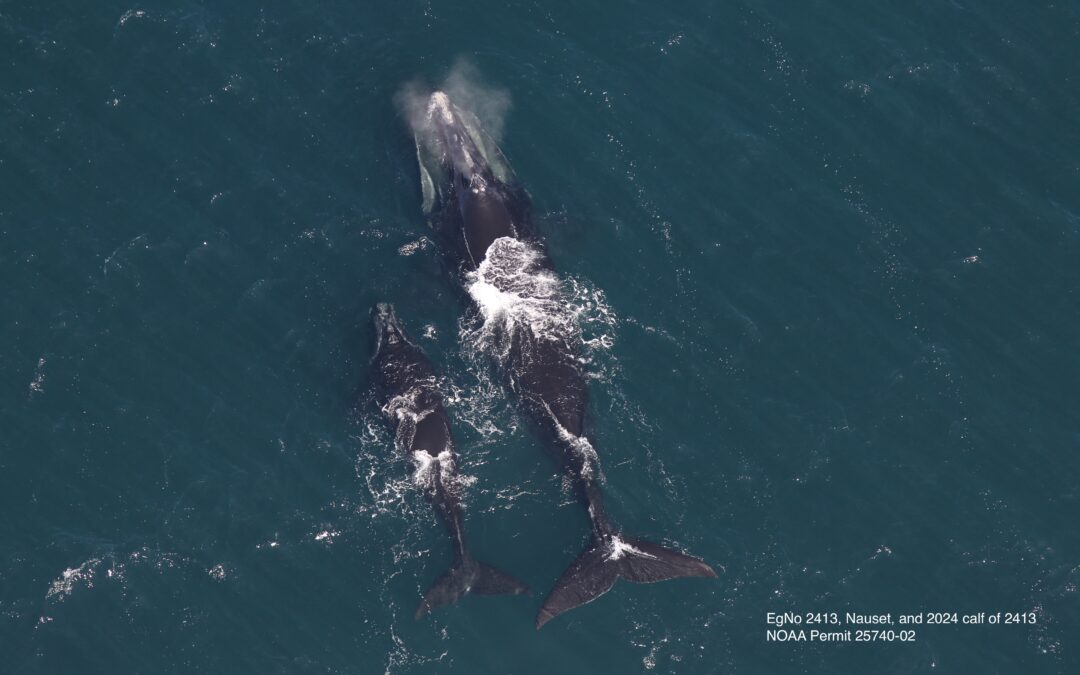
Aerial observers from the Center for Coastal Studies today observed a North Atlantic right whale mother with her calf in Cape Cod Bay, approximately five miles west of Great Island, Wellfleet. This is the first such sighting of a right whale calf in Massachusetts waters in the 2025 season.
The right whale mother was identified as 31-year-old Nauset (EgNo 2413). Nauset was first sighted with this newborn calf on December 1, 2024 off the coast of Georgia by an aerial survey conducted by Clearwater Marine Aquarium Research Institute. This is Nauset’s fifth known calf. Nauset’s first calf was a female, Canaveral, EgNo 3515, born in 2005 and last seen in 2015 and presumed dead; a second calf with no catalog number died on the calving grounds in 2011; a third calf, a female, Monomoy, EgNo 4313, is alive and well and was also sighted in Cape Cod Bay during this survey; and a fourth calf, a male, EgNo 5113, was born in 2021.
According to Ryan Schosberg, Aerial Observer and right whale researcher at the Center for Coastal Studies, “We were on our final track line of a busy survey day, when we spotted a pair of whales about a mile south of us. As we approached to document them, we knew we had to move quickly due to rising winds, which were nearing the upper limit of our survey parameters. Then to our surprise, a relatively small animal surfaced, and our initial confusion quickly turned to excitement when we realized this was our first right whale calf of the season! A few minutes later, the mother, who we identified as Nauset, surfaced next to the calf, as she took a brief pause from feeding beneath the surface.”
North Atlantic right whales calve off the coast of the southeast US in winter before migrating north to New England and Canadian feeding grounds. Each year, Cape Cod Bay is host to one of the largest feeding aggregations of right whales during winter and early spring. This season, researchers from the Center for Coastal Studies have already observed over 80 individual right whales in the bay.
The arrival of right whale mothers and their calves in Cape Cod Bay is an encouraging event, given that North Atlantic right whales are critically endangered. Their population is estimated to be just 372 individuals.
“The first sighting of mother/calf pairs in Cape Cod Bay each season is always an exciting moment that brings hope for the species. Their presence confirms successful calving in the southeastern U.S. during the winter months and marks a crucial stage in the calves’ early development. Given the critically endangered status of North Atlantic right whales, every birth is vital for population recovery. The long-term survival of the species depends on these calves, highlighting the urgent need to protect Cape Cod Bay as a critical habitat where they feed and nurse,” said Dr. Daniel Palacios, Director of the Center’s Right Whale Ecology Program
Ship strikes represent one of the greatest threats to North Atlantic right whales. Important efforts are being taken to reduce this danger. During right whale season, the Commonwealth of Massachusetts requires that vessels travel no faster than 10 knots in coastal waters and Cape Cod Bay where the whales aggregate.
Boaters, kayakers, paddle-boarders, swimmers and light aircraft and drone pilots are reminded that it is illegal to approach a North Atlantic right whale within 500 yards without a federal research permit. However, whales often feed very close to shore, offering watchers on the beach unbeatable views of one of the rarest of the marine mammals.
CCS right whale research and response operations are conducted in partnership with the Massachusetts Division of Marine Fisheries and NOAA under federal permits issued by the National Marine Fisheries Service. Support also comes from the Massachusetts Environmental Trust and contributions from other foundations, businesses and CCS supporters through the Center’s Right Whale Emergency Initiative.
Photo: Eg No 2413, Nauset, and 2024 Calf of 2413, photographed in Cape Cod Bay on March 11, 2025 by the Center for Coastal Studies Aerial Survey Team. NOAA Permit 25740-02.