UPDATE, FRIDAY, APRIL 18, 1:30 PM: An additional North Atlantic right whale mother/calf pair was sighted in Cape Cod Bay by the CCS aerial observer team this morning, after the publication of this release. The whales were identified as EgNo 4150, Accordion, and the 2025 calf of 4150. This brings the total number of mother/calf pairs observed in Cape Cod Bay this season to seven, all of who were seen today.
PROVINCETOWN, MA – Yesterday, aerial observers from the Center for Coastal Studies (CCS) spotted a previously undetected North Atlantic right whale mother and calf in Cape Cod Bay. The pair were approximately two miles north of Sandy Neck Beach, Barnstable, with a large aggregation of feeding right whales. It is rare for observers to spot a mom-calf pair not previously detected during the calving season in the Southeast U.S..
This is the sixth such sighting of a right whale calf in Massachusetts waters in the 2025 season. All told, researchers have now identified just 11 right whale calves born this season.
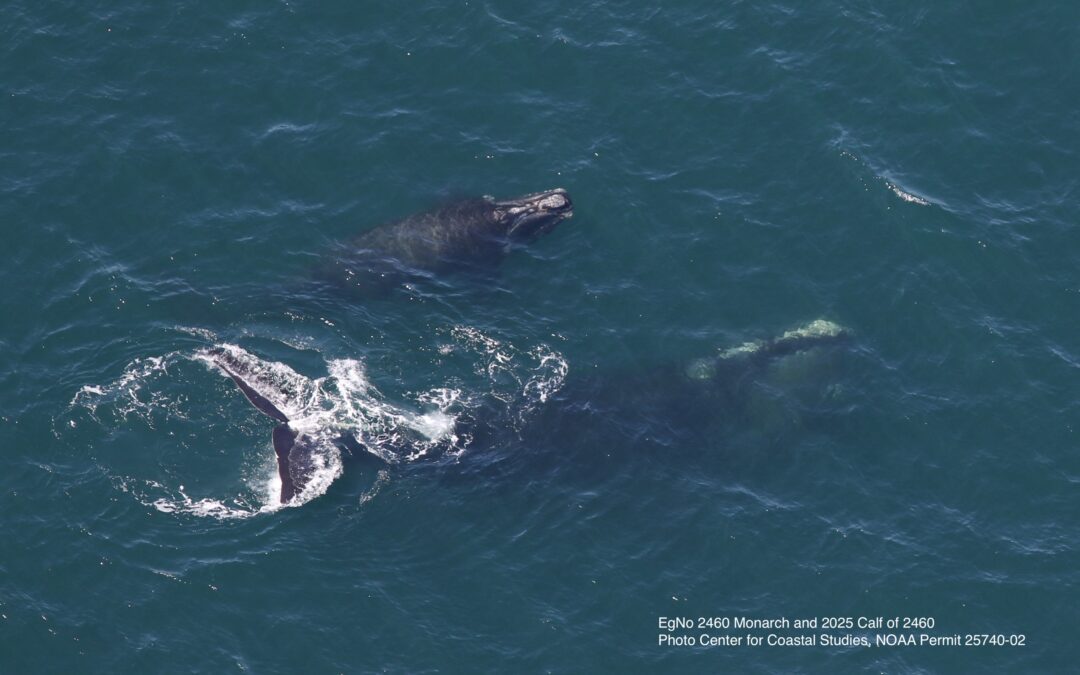
The right whale mother was identified as EgNo 2460, Monarch. Monarch is an adult female first observed in 1994 and this is her fifth known calf. Her previous calf, EgNo 5194, has also been observed by CCS in Cape Cod Bay this season. Her 2004 calf, EgNo 3420, Platypus, also had a calf this season but so far that pair have not been observed in the bay.
According to Ryan Schosberg, Aerial Observer and right whale researcher at the Center for Coastal Studies, “We had just begun documenting a new group of about a dozen subsurface feeding right whales when, to our surprise, a small calf suddenly surfaced in the middle of the group. We were certain that the scarring on the adult whale accompanying the calf didn’t match any of the mothers previously documented this season. After reviewing our photos, we were thrilled to realize the adult was EgNo 2460, Monarch – a known calving female, but one who hadn’t been seen with a calf this year! It’s very rare to be the first to document a new calf in the population when outside of the typical calving habitat, so this was a truly rewarding moment for our team.”
“This discovery is a bright spot in what remains a challenging conservation situation for North Atlantic right whales. Thanks to the sharp eyes and deep knowledge of our aerial observers, we’ve confirmed a new mom-calf pair—an encouraging sign for a species fighting to survive. Every calf matters,” said Dr. Daniel Palacios, Director of the Center’s Right Whale Ecology Program.
North Atlantic right whales calve off the coast of the Southeast U.S. in winter before migrating north to New England and Canadian feeding grounds. Each year, Cape Cod Bay is host to one of the largest feeding aggregations of right whales during winter and early spring. This season, researchers from the Center for Coastal Studies have already observed 180 individual right whales in the bay.
It is encouraging to see right whale mothers and their calves in Cape Cod Bay, given that North Atlantic right whales are critically endangered. Their population is estimated to be just 372 individuals.
“Every calf is a lifeline for this endangered species, and this discovery wouldn’t have been possible without the skill and dedication of our aerial observers. Confirming Monarch with a new calf in real time is a powerful reminder of what’s possible through vigilant observation and strong collaboration across the right whale scientific community,” added Dr. Palacios.
“North Atlantic right whales rely on a healthy marine environment and, in turn, they help keep the ocean a vital, vibrant part of our planet. In short, if they thrive, we thrive,” said CCS Executive Director Anne-Marie Runfola.
Ship strikes represent one of the greatest threats to North Atlantic right whales. Important efforts are being taken to reduce this danger. During right whale season, the Commonwealth of Massachusetts requires that vessels travel no faster than 10 knots in coastal waters and Cape Cod Bay where the whales aggregate.
Entanglements also represent a serious threat to right whales. Since 1984, the Center for Coastal Studies has freed more than 200 large whales and other marine animals from life threatening entanglements, using techniques developed by Center staff.
Boaters, kayakers, paddle-boarders, swimmers and light aircraft and drone pilots are reminded that it is illegal to approach a North Atlantic right whale within 500 yards without a federal research permit. However, whales often feed very close to shore, offering watchers on the beach unbeatable views of one of the rarest of the marine mammals.
CCS right whale research and response operations are conducted in partnership with the Massachusetts Division of Marine Fisheries and NOAA under federal permits issued by the National Marine Fisheries Service. Support also comes from the Massachusetts Environmental Trust and contributions from other foundations, businesses and CCS supporters through the Center’s Right Whale Emergency Initiative.
Photo: EgNo 2460 Monarch and 2025 Calf of 2460, photographed in Cape Cod Bay on April 17, 2025 by the Center for Coastal Studies Aerial Survey Team. NOAA Permit 25740-02.